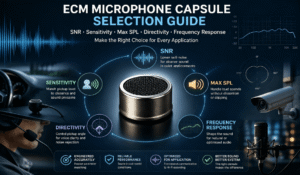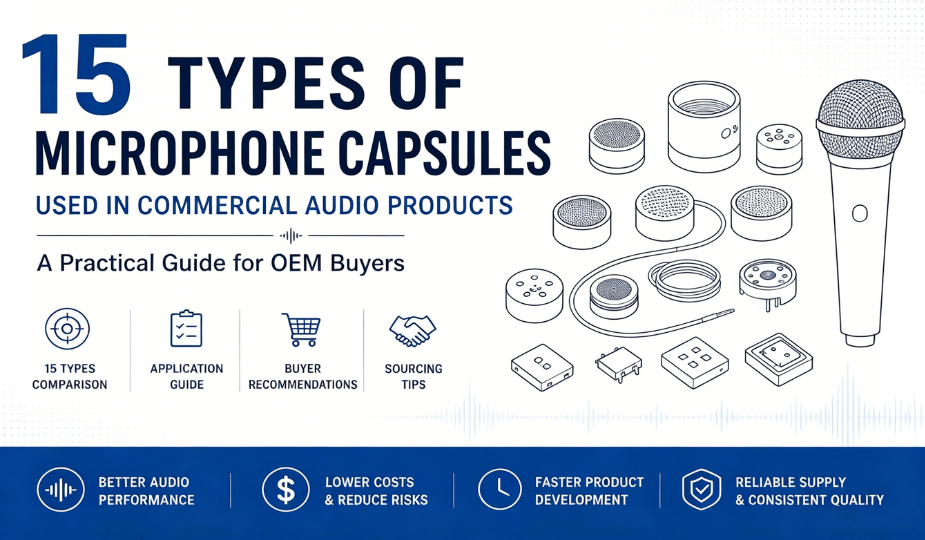
Selecting the right microphone capsule can improve product performance, reduce development risks, and help your team reach mass production faster.
Many OEM buyers focus on microphone specifications after the product design is nearly complete. In practice, this often leads to acoustic issues, redesign costs, and project delays.
If you are developing a headset, conference system, body camera, smart device, or professional audio product, understanding the major microphone capsule types can help you make better sourcing decisions from the start.
Quick Comparison of Microphone Capsule Types
| Type | Best For | Cost Level | Main Advantage |
|---|---|---|---|
| Electret Condenser (ECM) | Headsets, Conference Systems | Low | Excellent balance of cost and performance |
| MEMS | IoT Devices, Smart Electronics | Medium | Supports automated SMT production |
| Dynamic | Stage and Broadcast Equipment | Medium | Handles high sound pressure levels |
| Noise-Canceling | Communication Headsets | Medium | Reduces background noise |
| Waterproof | Outdoor Products | High | Improved environmental protection |
Why Microphone Capsule Selection Matters
A microphone capsule is not simply an audio component. It directly affects voice clarity, user experience, production consistency, and product reliability.
The wrong capsule can increase engineering work and create unnecessary warranty costs after launch.
For OEM manufacturers, selecting the correct microphone early can significantly reduce project risks.
1. Electret Condenser Microphone Capsules
Electret condenser microphones remain the most widely used microphone technology in commercial audio products.
Typical Applications
- Conference systems
- Headsets
- Security cameras
- Intercom systems
Buyer Recommendation
If your project requires strong voice performance while maintaining cost competitiveness, ECM capsules are often the safest choice.
For many OEM products, ECM technology still delivers the best overall value.
2. MEMS Microphones
MEMS microphones are manufactured using semiconductor processes and support highly automated production.
Typical Applications
- Smart speakers
- Wearable devices
- IoT products
- Voice-controlled electronics
Buyer Recommendation
If your production relies heavily on SMT assembly, MEMS microphones may improve manufacturing efficiency and consistency.
3. Dynamic Microphone Capsules
Dynamic microphone capsules use a moving coil structure and perform well in high-noise environments.
Typical Applications
- Broadcast microphones
- Stage microphones
- Public address systems
- Communication equipment
Buyer Recommendation
For products operating in demanding environments, dynamic capsules often provide long-term reliability advantages.
4. Omnidirectional Microphone Capsules
Omnidirectional microphones capture sound from all directions.
They are commonly used when the user’s speaking position cannot be controlled.
5. Cardioid Microphone Capsules
Cardioid microphones focus on sound from the front while reducing unwanted noise from other directions.
6. Supercardioid Microphone Capsules
Supercardioid microphones offer narrower pickup patterns and improved noise rejection.
7. Noise-Canceling Microphone Capsules
Noise-canceling designs improve speech intelligibility in noisy environments.
8. Dual-Capsule Microphone Systems
Dual-capsule designs combine signals from multiple microphones for better voice processing performance.
9. Analog MEMS Microphones
Analog MEMS microphones simplify integration with traditional audio circuits.
10. Digital MEMS Microphones
Digital MEMS microphones provide outputs such as PDM and I²S.
11. Waterproof Microphone Capsules
Designed for products exposed to dust, moisture, and outdoor conditions.
12. Automotive-Grade Microphone Capsules
Built for long-term reliability under vibration and temperature fluctuations.
13. Broadcast-Grade Microphone Capsules
Optimized for professional audio applications where sound quality is critical.
14. Miniature Microphone Capsules
Ideal for compact electronic devices with limited installation space.
15. Custom-Tuned Microphone Capsules
Custom acoustic tuning helps OEM manufacturers create differentiated products.
Which Microphone Capsule Is Best for Your Application?
| Application | Recommended Type |
|---|---|
| Conference Systems | Omnidirectional ECM |
| Communication Headsets | Noise-Canceling ECM |
| Body Cameras | Waterproof ECM |
| Smart Speakers | Digital MEMS |
| Broadcast Equipment | Dynamic or Broadcast-Grade ECM |
Frequently Asked Questions
What is the most common microphone capsule type?
Electret condenser microphones remain one of the most widely used solutions due to their cost-effectiveness and strong audio performance.
Are MEMS microphones replacing ECM microphones?
Not entirely. Both technologies continue serving different application requirements.
Which microphone is best for headsets?
Many communication headsets use noise-canceling ECM designs for improved voice clarity.
Which microphone type works best outdoors?
Waterproof microphone capsules are generally preferred for outdoor applications.
Can microphone capsules be customized?
Yes. Many OEM projects require custom sensitivity, frequency response, or acoustic tuning.
How important is SNR?
SNR directly affects perceived audio quality and voice clarity.
What is the difference between analog and digital MEMS?
Analog MEMS provide analog outputs, while digital MEMS support formats such as PDM and I²S.
When should microphone selection begin?
Ideally during the early product design stage to avoid costly redesigns later.
How many samples should I evaluate?
Most OEM projects compare multiple samples under real-world operating conditions.
What factors affect microphone reliability?
Environmental conditions, supplier consistency, manufacturing quality, and acoustic design all play important roles.
Need Help Selecting the Right Microphone Capsule?
ECMIC supports OEM manufacturers with electret condenser microphones, MEMS microphones, dynamic microphone capsules, and custom acoustic tuning solutions.
Contact our engineering team to discuss your application requirements and sourcing goals.