At ECMIC, we manufacture both electret condenser microphone capsules and MEMS microphones for OEM and ODM customers worldwide. One of the most common questions from engineers and product developers is:
Should I choose a MEMS microphone or an electret condenser microphone for my product?
The answer is not as simple as choosing the “newer” or “smaller” technology. In real product design, the selection depends on system architecture, acoustic requirements, manufacturing process, and cost targets.
MEMS vs Electret Is Not a Product Category Decision
Many people try to decide microphone type based on the product itself (for example: “TWS uses MEMS” or “headsets use electret”). In practice, this is not accurate.
The real decision depends on system-level design factors such as:
- PCB space and mechanical structure
- Number of microphones in the system
- Analog vs digital audio architecture
- Signal processing (DSP / AI / beamforming)
- Manufacturing method (SMT vs manual assembly)
- Cost and supply chain requirements
That’s why two products in the same category can use completely different microphone technologies.
Why MEMS Microphones Are Widely Used in Modern Smart Devices
MEMS microphones are increasingly used in compact and smart electronic devices, especially where high integration and digital processing are required.
TWS Earbuds
In true wireless earbuds, space is extremely limited, and multiple microphones are often required for ANC (Active Noise Cancellation), ENC (Environmental Noise Cancellation), and beamforming.
Based on ECMIC engineering experience in OEM projects, MEMS microphones are preferred because they offer:
- Ultra-compact package size
- Excellent unit-to-unit consistency
- SMT-friendly manufacturing
- Better performance in multi-microphone arrays
Smart Glasses
Smart glasses require extremely thin acoustic and electronic designs. MEMS microphones are widely used due to their small footprint and surface-mount compatibility.
Action Cameras and Wearables
Devices like action cameras and wearable electronics often require waterproofing, vibration resistance, and compact integration. MEMS microphones are well-suited for these requirements.
AI Smart Speakers
Smart speakers typically use multiple microphones for far-field voice pickup and beamforming algorithms. MEMS microphones provide the consistency needed for array-based voice processing.
Why Electret Condenser Microphones Are Still Widely Used
Despite the growth of MEMS microphones, electret condenser microphones (ECMs) remain widely used in many professional and cost-sensitive applications.
Lavalier and Broadcast Microphones
Electret capsules are commonly used in lavalier microphones because they offer natural sound reproduction, high sensitivity, and mature analog design performance.
Headset Boom Microphones
ECMIC supplies electret microphone capsules for aviation headsets, industrial communication systems, call centers, and intercom devices.
These applications often prioritize stable analog performance and cost efficiency over extreme miniaturization.
AI Voice Toys and Entry-Level Devices
Many AI-enabled toys and simple voice devices still use electret microphones due to their lower system cost and sufficient performance for single-microphone applications.
Why Some Products Can Use Either MEMS or Electret
Some product categories do not have a fixed microphone choice. The decision depends on product positioning and system complexity.
Smart Watches
Entry-level smart watches often use electret microphones for cost efficiency and basic voice calling functions.
High-end smart watches with AI voice assistants, dual-microphone noise reduction, and waterproof designs are more likely to use MEMS microphones.
Conference and Industrial Devices
Devices such as conference systems, handheld terminals, and industrial communication equipment may use either MEMS or electret microphones depending on design requirements.
MEMS vs Electret Microphones: Quick Comparison
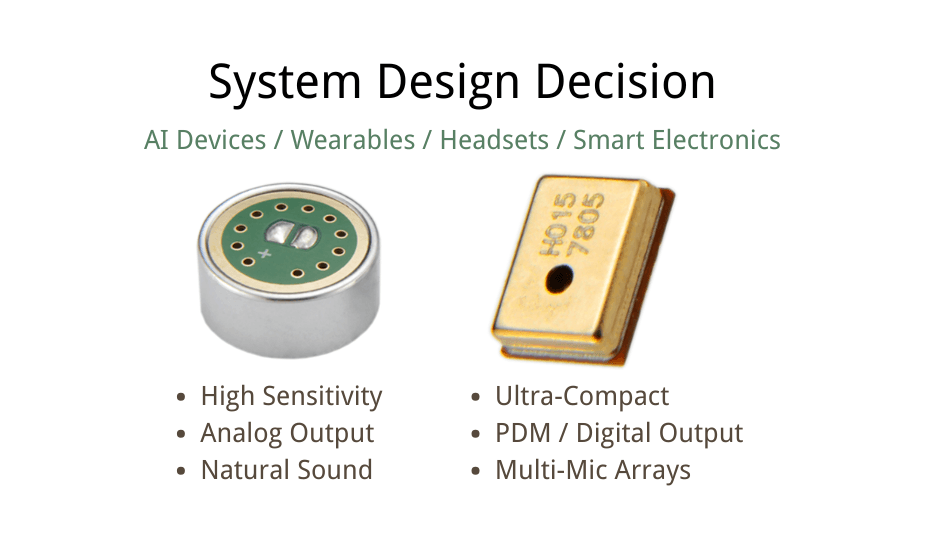
| Requirement | More Suitable Technology |
|---|---|
| Lowest cost | Electret (ECM) |
| Ultra-compact design | MEMS |
| Multi-microphone arrays | MEMS |
| Analog audio systems | Electret (ECM) |
| Digital audio (PDM interface) | MEMS |
| Professional lavalier use | Electret (ECM) |
| Wearable waterproof devices | MEMS |
| AI beamforming systems | MEMS |
How ECMIC Supports OEM and ODM Projects
At ECMIC, we understand that microphone selection is not just about specifications—it is about system integration and real-world product performance.
We work closely with OEM and ODM manufacturers to help select the right microphone solution based on:
- Acoustic performance requirements
- Mechanical and PCB constraints
- Signal processing architecture
- Environmental conditions (waterproof, vibration, etc.)
- Production cost and scalability
Our product portfolio includes:
- Electret condenser microphone capsules
- MEMS microphones
- Dynamic microphone capsules
Conclusion
MEMS microphones and electret condenser microphones are not competing technologies in a simple sense. Instead, they serve different roles in modern electronic product design.
MEMS is preferred in highly integrated, multi-microphone, and digital systems. Electret remains strong in analog, cost-sensitive, and professional audio applications.
The key question is not “which microphone is better”, but “which microphone fits your system design best.”
Need Help Choosing a Microphone?
If you are developing AI devices, smart wearables, headsets, intercom systems, or consumer electronics, ECMIC can help you evaluate the most suitable microphone solution for your application.
Contact our engineering team for OEM/ODM support and technical recommendations.