Electret condenser microphones (ECMs) do not follow a unified industry naming standard. Manufacturers often encode capsule dimensions, acoustic performance, terminal type, and internal codes in their model numbers. In this article, we explain common electret microphone naming rules and introduce ECMIC’s structured model naming system.
1. Overview of Electret Microphone Model Naming
Why Electret Microphone Model Names Differ by Manufacturer
Because no global naming standard exists, each electret microphone manufacturer develops its own model naming logic to reflect design philosophy, production structure, and application focus.
What Information Is Typically Encoded in a Model Number
A typical electret microphone model number may include size, sensitivity, directivity, transistor type, and internal identification codes.
2. Dimension-Based Electret Microphone Naming
Diameter and Height Coding System
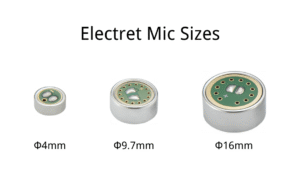
Many electret microphones use a four-digit size code. The first two digits represent the capsule diameter in millimeters, while the last two digits indicate capsule height.
Common Size Code Examples
- 4015: 4.0 mm diameter, 1.5 mm height
- 6027: 6.0 mm diameter, 2.7 mm height
- 6050: 6.0 mm diameter, 5.0 mm height
- 9745: 9.7 mm diameter, 4.5 mm height
- 9767: 9.7 mm diameter, 6.7 mm height
Size Series Classification
Some manufacturers classify electret microphones into size-based series, such as 3.0 mm, 4.0 mm, 6.0 mm, and 9.7 mm series, to simplify product selection.
3. Performance Parameters in Electret Microphone Model Names
Sensitivity Identification
Sensitivity values such as -30 dB, -36 dB, or -46 dB may be embedded in the model name to indicate microphone output level under standard test conditions.
Directivity Indicators
Electret microphones may be omnidirectional or unidirectional (cardioid), and this information can appear as a letter code in the model name.
Operating Voltage and Electrical Characteristics
In some models, operating voltage or specific electrical parameters are included to highlight application compatibility.
4. Manufacturer-Specific Naming Conventions
Structural Differences
Model prefixes or letters may be used to distinguish between back electret and foil electret structures.
Packaging and Mounting Types
SMD, solder pad, or pin-type configurations may be reflected in the model code.
Application-Oriented Variants
Additional identifiers may indicate low-noise design, high AOP, or specialized acoustic tuning for specific applications.
5. ECMIC Electret Microphone Model Naming System
ECMIC Naming Philosophy
ECMIC adopts a structured and transparent naming system that allows engineers and buyers to understand key specifications directly from the model number.
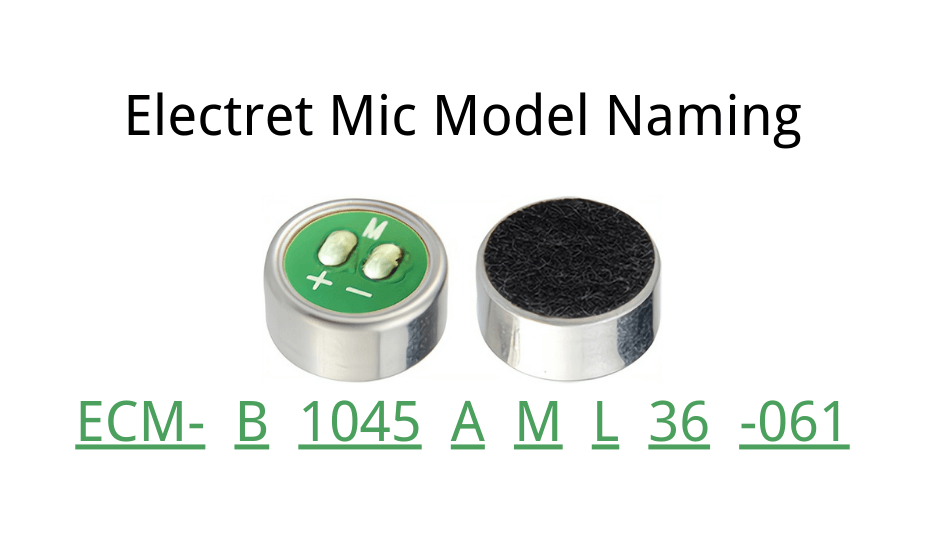
ECMIC Model Code Structure
- ECM: Brand identifier (ECMIC)
- B: Back electret structure
- 1045: Capsule size (Ø10 mm × 4.5 mm)
- A: Omnidirectional
- L / P: L = leadless / wireable, P = pin type
- M: MOSFET transistor (if included)
- 36: Sensitivity (-36 dB)
- 061: Internal factory code
6. Example: Reading an ECMIC Model Number
ECM-B1045AML36-061

This model is a Ø10 × 4.5 mm back electret microphone with omnidirectional pickup, leadless terminals that can be wired if needed, an optional MOSFET transistor, and -36 dB sensitivity.
JFET vs. MOSFET Identification
Models without the letter “M” use JFET by default, while models marked with “M” indicate MOSFET designs suitable for lower noise and higher-end applications.
7. Advantages of ECMIC’s Naming System
- Fast identification of key specifications
- Reduced communication time during sourcing
- Clear differentiation between standard and premium models
- Scalable structure for OEM and custom projects
8. Conclusion
Although electret microphone model naming varies by manufacturer, most systems combine size, performance, and structure information. ECMIC’s naming logic is designed to be clear, consistent, and engineer-friendly.