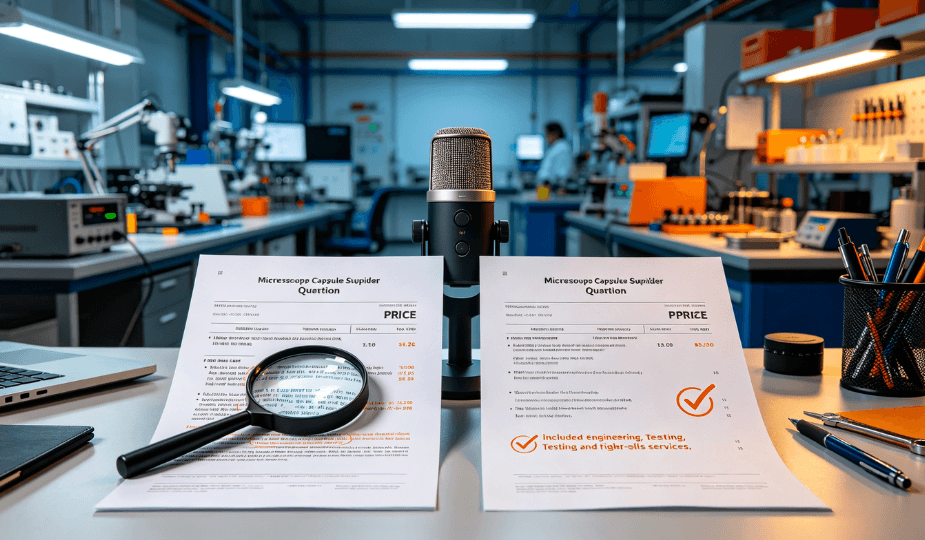
When sourcing microphone capsules, it is common to receive significantly different quotations for products that appear identical on paper. However, the difference is usually caused by factors beyond the unit price.
We are ECMIC, a microphone capsule manufacturer based in China. We work with OEM buyers worldwide, and we see price confusion like this every day. In this guide, we explain the key factors that determine microphone capsule pricing and supplier quotation differences — from our perspective on the factory floor.
By the end, you will know how to compare quotations based on total cost of ownership, not just unit price.
Why Price Differences Are Not What They Seem
The microphone capsule market has a wide price spread. A dynamic microphone capsule can vary significantly in price depending on size, materials, acoustic performance, and customization requirements. Electret condenser capsules show similar variations.
But the price on the quotation is rarely the full story. Here are the key factors that determine microphone capsule pricing and supplier quotation differences.
Factor 1: Raw Material Quality
Not all microphone capsules are made with the same components, even when they share the same product name.
What varies:
- Diaphragm material: Higher-grade films cost more but offer better consistency and longevity.
- FET quality: The internal transistor that amplifies the signal. Low-grade FETs introduce more noise and have wider performance drift.
- Backplate and housing: Precision-machined metal components vs. stamped alternatives.
In practice, material selection affects not only acoustic performance but also consistency between production batches.
Buyer tip: Ask your supplier about the specific materials they use, especially for the diaphragm and FET. A supplier who cannot tell you these details may be using the lowest-grade components available. For a deeper understanding of how electret condenser microphones work, see our guide on ECM working principle.
Factor 2: Test Coverage
This is the biggest hidden cost difference between suppliers.
100% testing vs. batch sampling:
- Some suppliers test every single capsule for sensitivity, SNR, and frequency response.
- Others test only a sample from each batch, assuming the rest will perform the same.
The real cost: When a supplier skips individual testing, they also skip removing defective units. Those defective capsules end up in your shipment, fail on your production line, and create rework costs that far exceed the pennies you saved.
From our experience at ECMIC: We consider acoustic testing one of the most critical steps in microphone capsule manufacturing. Every production batch is evaluated against defined acoustic parameters before shipment. This helps reduce the risk of inconsistent performance after delivery.
Buyer tip: Ask your supplier what percentage of their production undergoes full acoustic testing. The answer will tell you a lot about their price.
Factor 3: Process Control Capability
CPK (Process Capability Index) measures how consistently a manufacturer produces parts within specification. A CPK ≥ 1.33 indicates a capable process in many industries.
What CPK tells you:
- A supplier with high CPK invests in process monitoring, calibration, and statistical quality control.
- A supplier with low CPK produces more variation from unit to unit — meaning some capsules pass, some barely pass, and some fail.
Buyer tip: For high-volume projects, ask suppliers whether they monitor process capability for key parameters such as sensitivity, impedance, and SNR. A supplier who cannot provide this data may not have full control over their production process. Learn more about electret microphone capsule types and their specifications.
Factor 4: Engineering Support and Customization
A lower-cost supplier often treats the capsule as a commodity — you buy what they make, and they provide minimal technical support.
A higher-cost supplier typically offers:
- Technical consultation during your design phase.
- Custom tuning of frequency response or sensitivity.
- Guidance on acoustic port placement and seal design.
- Support during your prototype and validation stages.
Buyer tip: Engineering support costs money, but it also saves development time. A supplier who helps you get the design right the first time can reduce your time-to-market by weeks. Factor this into your comparison. For more on this topic, see our guide on OEM microphone capsule customization options.
Factor 5: Supply Chain Risk Management
Some suppliers may not maintain sufficient buffer stock of critical components. When raw material prices rise or demand surges, buyers may face delays, expedite fees, or allocation shortages.
Suppliers with stronger supply chain management may maintain raw material buffer stock to reduce the impact of market fluctuations and component shortages.
Buyer tip: Ask each supplier about their raw material buffer policy. If one supplier holds buffer stock and another does not, that is worth actual dollars in supply chain risk reduction.
How to Compare Quotations Like a Procurement Professional
When you receive multiple quotes for microphone capsules, use this checklist to compare apples to apples:
- Does the supplier provide CPK data? Available → better process visibility. Not available → higher uncertainty.
- Does the supplier perform defined acoustic testing on production units? Yes → better consistency control. No → higher variation risk.
- Does the supplier offer engineering support? Yes → faster development and problem solving. No → more internal engineering effort.
- Does the supplier hold raw material buffer stock? Yes → lower supply risk. No → exposed to shortages.
- Does the supplier specify their diaphragm material and FET grade? Yes → transparency. No → potential quality issues.
Understanding Total Cost of Ownership
The following example shows why a higher unit price supplier may still provide a lower overall cost.
| Cost Factor | Supplier A (Lower Unit Price) | Supplier B (Higher Unit Price) |
|---|---|---|
| Unit Price | Lower | Higher |
| Incoming Inspection Cost | Higher risk (more defects to catch) | Lower risk |
| Production Failure Risk | Higher | Lower |
| Engineering Support | Limited or additional cost | Available |
| Supply Stability | Depends on buffer stock | Usually stronger |
The cheapest quotation is not always the lowest total cost. The actual impact depends on your production volume, failure rate, and internal labor cost.
For a complete overview of available options, browse our full range of microphone capsules.
Frequently Asked Questions
What should a complete microphone capsule quotation include?
A professional quotation should include unit price, tooling cost (if custom tuning), sample charges, lead time, MOQ, payment terms, and a test specification that lists what parameters are tested and at what frequency.
How can I tell if a low price means low quality?
Ask about test coverage and process control. A lower price may come from different materials, testing methods, production scale, or quality control approaches. Understanding these differences helps you compare suppliers more accurately.
What is the relationship between MOQ and unit price?
Higher MOQ typically lowers unit price because fixed costs (tooling, setup, testing) are spread across more units. Ask for a tiered pricing table so you can see how price changes with volume.
What is a reasonable price for an ECM capsule?
Prices vary widely based on specifications, volume, testing requirements, and customization level. A standard ECM capsule may have a very different price compared with a high-SNR, noise-canceling, waterproof, or customized design. Always compare quotations based on specifications and total cost, not unit price alone.
Why does the same supplier quote different prices over time?
Raw material costs fluctuate, especially for specialty components like diaphragms and FETs. A reputable supplier will transparently explain price changes rather than absorbing them in ways that affect quality.
What is the typical lead time difference between low-cost and high-cost suppliers?
Lead time depends on production capacity, component availability, order quantity, and supplier planning. Suppliers with stronger inventory management and production control are generally better prepared to handle urgent demand changes.
Need a Second Opinion on Your Microphone Quotation?
ECMIC (Shenzhen Marquess Electronics Co., Ltd.) provides transparent quotations, production quality control, and engineering support for OEM buyers worldwide.
If you are comparing microphone capsule suppliers or reviewing a quotation, our engineering team can help evaluate specifications, pricing structure, and production capability. Contact our procurement engineering team for a confidential review.