When selecting speakers and receivers for electronic devices, impedance matching is one of the key factors, rather than appearance or size. Standard low impedance models are suitable for most consumer electronics, while industrial and specialized systems often require high impedance versions.
Understanding the difference between low and high impedance helps buyers and engineers select the correct components and avoid mismatch issues such as low volume, distortion, or unstable system performance.
This guide introduces impedance characteristics, application scenarios, and standard customization methods for high impedance speakers and receivers based on practical manufacturing experience.
1. Low Impedance Speakers & Receivers (Standard In-Stock Models)
Low impedance speakers and receivers are widely used in consumer electronics and commercial devices. They are easy to drive, compatible with standard circuit boards, and suitable for large-scale production.
1.1 Low Impedance Speaker Specifications & Applications
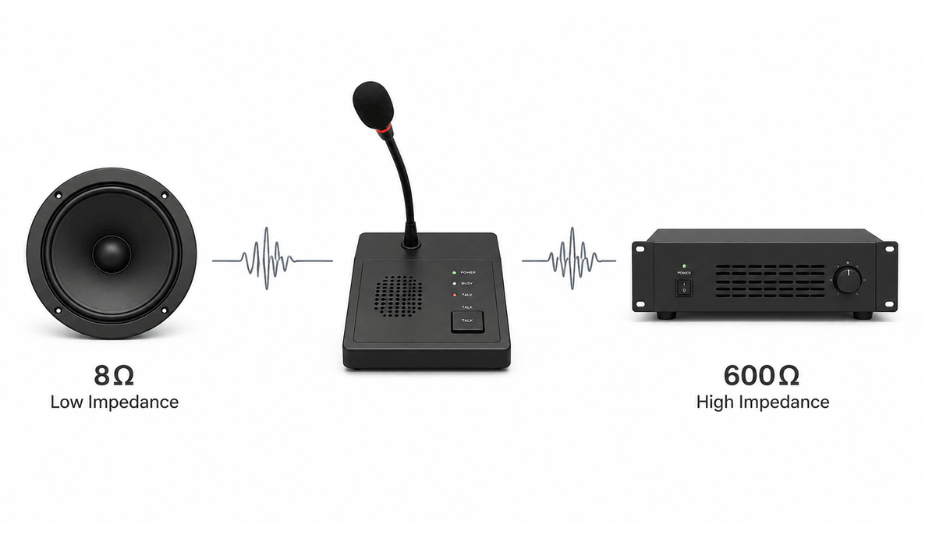
Common impedance values: 4Ω, 8Ω, 16Ω, 32Ω. Among them, 8Ω and 16Ω are the most widely used standard values.
Low impedance speakers provide stable performance and are suitable for general sound output, prompt tones, and basic audio playback.
Applications: Consumer electronics, portable speakers, toys, home appliances, embedded sound output devices.
1.2 Low Impedance Receiver Specifications & Applications
Common impedance values: 32Ω, 50Ω, 64Ω. These receivers are designed for clear voice reproduction in short-distance communication scenarios.
They offer low power consumption, stable performance, and do not require complex circuit adjustments.
Applications: Intercom systems, telecommunication devices, handheld communication equipment.
2. High Impedance Speakers & Receivers (Custom, Non-Stock Models)
High impedance models such as 150Ω, 300Ω, 600Ω, 1000Ω are typically custom-made and not available as standard stock.
There is no quality difference between low and high impedance products — the difference lies in circuit matching and system design requirements.
They cannot be directly interchanged due to different driving conditions and output characteristics.
High impedance designs are not intended for high-power or high-fidelity audio playback, but for stable signal transmission in industrial environments.
They are especially suitable for long-distance wiring, anti-interference requirements, and multi-device parallel systems.
Applications: Industrial intercom systems, emergency communication terminals, long-distance transmission systems, instrumentation alerts, and multi-device parallel control systems.
3. Key Difference Between Low and High Impedance
The primary difference lies in the electrical impedance value.
However, the appearance, structure, and installation dimensions can remain exactly the same.
Selection should be based on circuit design and driving requirements, not on product size or appearance.
4. High Impedance Customization Method
High impedance speakers and receivers are typically achieved by adjusting internal electrical parameters based on standard low impedance units.
This approach ensures stable performance, consistent quality, and reliable mass production.
Customization does not require changes to the external structure or installation dimensions, allowing seamless integration into existing product designs.
Frequently Asked Questions (FAQ)
1. What happens if speaker impedance is mismatched?
Impedance mismatch may result in low volume, distortion, or no sound output. In some cases, it may also affect the stability of the driving circuit.
2. Can I replace an 8Ω speaker with a 600Ω speaker?
No. Low impedance and high impedance speakers are designed for different circuit conditions. Direct replacement will result in insufficient output or improper system operation.
3. Why are high impedance speakers and receivers usually custom-made?
High impedance models are mainly used in industrial systems and are typically produced based on specific project requirements rather than standard stock.
4. Does higher impedance mean better sound quality?
No. Sound quality depends on multiple factors such as sensitivity, frequency response, and system design, not impedance alone.
5. Can high impedance speakers be used for long-distance transmission?
Yes. High impedance designs are more suitable for long-distance transmission and multi-device systems, helping improve stability and reduce interference.
6. Will customization change the size or structure?
No. High impedance customization typically keeps the same external dimensions and mounting structure, allowing direct integration into existing designs.