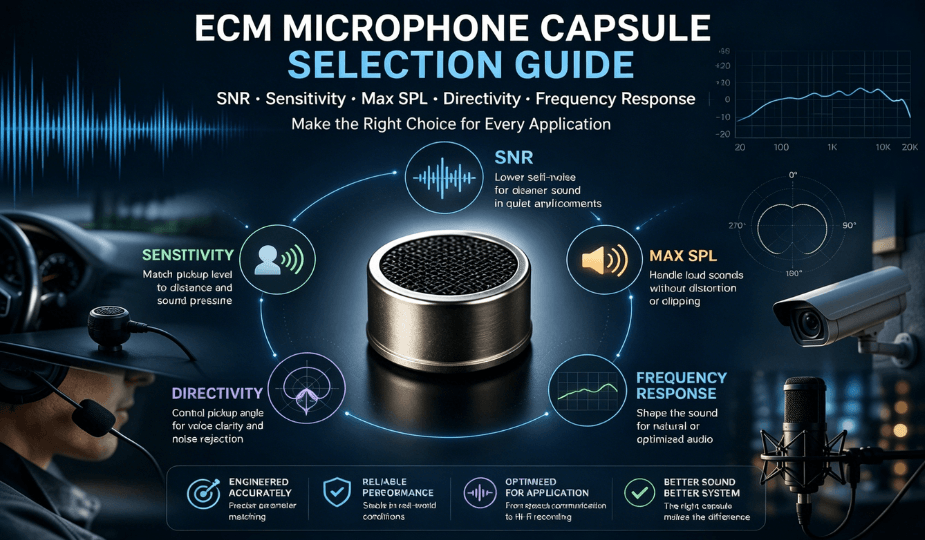
This aggregate page concludes our foundational ECM technical series. It summarizes key concepts from our Signal-to-Noise Ratio (SNR) and Sensitivity guides while introducing practical engineering considerations in real-world applications, including noisy environments, acoustic overload limits, and application-specific sound design trade-offs.
For detailed explanations and case studies, please refer to the internal links below.
1. Quiet Environment Performance (SNR)
SNR primarily determines microphone self-noise performance in quiet environments. When ambient noise significantly exceeds the microphone’s self-noise floor, environmental noise becomes the dominant factor, reducing the practical impact of SNR on speech intelligibility.
2. Sensitivity Selection Principles
Sensitivity selection is primarily determined by three factors:
- Sound source distance
- Expected sound pressure level (SPL)
- Presence of nearby loudspeakers or acoustic feedback risk
Higher sensitivity improves weak or distant sound pickup but reduces acoustic overload margin. Lower sensitivity improves tolerance to loud sound sources and reduces distortion risk in high-SPL environments.
3. Noisy Environment Acoustic Matching
In real-world noisy environments, microphone performance depends on the combined interaction of Sensitivity, Directivity, and Frequency Response rather than a single specification.
- Noisy far-field applications (surveillance / monitoring): Higher sensitivity + Broad pickup pattern + Low-frequency roll-off
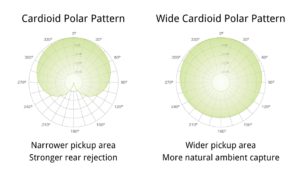
- Noisy close-talk applications (headsets / intercom systems): Moderate sensitivity + Directional pickup + Vocal-band frequency optimization
- Speaker-equipped systems (automotive / intercom / devices): Lower sensitivity + Higher Max SPL capability + Anti-feedback frequency tuning
4. Max SPL and Distortion Limits
Max SPL defines the maximum sound pressure level a microphone can handle before significant distortion occurs.
In many ECM designs, higher sensitivity is often associated with lower Max SPL capability, creating a practical trade-off between pickup gain and acoustic overload tolerance. Applications involving loud environments or nearby speakers typically require higher Max SPL performance.
5. Hi-Fi vs Speech-Optimized Design
Microphone design goals vary depending on the application. Voice communication systems prioritize speech intelligibility, while high-fidelity systems prioritize accurate sound reproduction.
Speech-optimized microphones (such as headsets, intercoms, automotive systems, and security devices) often use frequency shaping to enhance vocal clarity and reduce environmental noise.
High-fidelity applications aim to preserve the original acoustic characteristics of the sound source. This typically requires a flatter frequency response, lower distortion, and higher signal-to-noise performance.
Within ECM capsule designs, omnidirectional single-port structures are commonly used when accurate sound reproduction and frequency-response consistency are required.
6. Final Systematic Conclusion
- Quiet environment performance → Primarily influenced by SNR
- Sensitivity selection → Determined by distance, SPL, and feedback risk
- Noisy environment performance → Determined by sensitivity, directivity, and frequency-response tuning
- Distortion limits → Governed by Max SPL and acoustic design constraints
- Design objective → Choose between speech optimization and high-fidelity accuracy based on application requirements