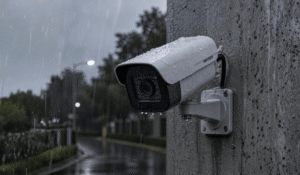
Security cameras use microphone capsules for different purposes, from capturing conversations near an entrance to monitoring ambient sounds in parking areas, commercial buildings, and industrial sites. The right microphone capsule depends on the camera’s acoustic requirements, installation structure, operating environment, and audio processing system.
For OEMs and manufacturers developing security cameras, selecting a microphone capsule involves more than sensitivity alone. Directivity, frequency response, environmental protection, mechanical mounting, and compatibility with the audio circuit all affect the final performance.
1. Identify the Camera’s Primary Audio Requirement
Before selecting a microphone capsule, define what the camera needs to capture. A camera designed for two-way communication may prioritize speech clarity, while a monitoring device may need to capture a wider range of environmental sounds.
- Indoor dome and bullet cameras: Capture nearby speech and relevant ambient sounds within the intended coverage area.
- Entrance and access-control cameras: Support voice capture near doors, gates, and visitor interaction points.
- Retail and commercial cameras: Operate in environments with background conversations, ventilation noise, and other competing sounds.
- Outdoor security cameras: Account for rain exposure, wind noise, temperature variation, and the physical design of the enclosure.
- Industrial and parking-area cameras: Consider machinery noise, vehicle sounds, reverberation, and potentially demanding environmental conditions.
These applications do not necessarily require different microphone technologies. The appropriate choice depends on the required pickup pattern, acoustic performance, environmental protection, and overall system design.
2. Choose the Appropriate Microphone Directivity
Microphone directivity describes how a capsule responds to sounds arriving from different directions. It should be matched to the intended pickup area and the camera’s physical installation.
Omnidirectional microphone capsules
An omnidirectional capsule is designed to pick up sound from multiple directions. It can be suitable for compact security cameras that need to capture nearby speech and surrounding ambient sounds without requiring a narrowly defined pickup direction.
Omnidirectional capsules are worth considering for indoor cameras, entrance cameras, and many general-purpose surveillance designs. However, they also capture sound arriving from outside the target area, so background noise and room acoustics remain important.
Unidirectional microphone capsules
A unidirectional capsule emphasizes sound from a preferred direction. It may be appropriate when the camera has a defined target area and the microphone can be positioned and oriented accordingly.
The actual directional response depends on the capsule design and its installation. The camera housing, sound inlet, internal cavity, and nearby surfaces can alter the acoustic response, so testing should be performed in the final enclosure.
3. Indoor Security Cameras: Focus on Speech and Installation
Indoor surveillance cameras are commonly installed in offices, shops, corridors, lobbies, and residential buildings. Although these environments are generally protected from direct weather exposure, their acoustic conditions can vary considerably.
Offices, corridors, and lobbies
Hard walls, glass, and tiled surfaces can produce reflections and reverberation. A capsule with suitable speech-band response is only one part of the solution; microphone placement and the camera’s audio processing also influence intelligibility.
Retail stores and commercial spaces
Background conversations, public announcements, and ventilation systems can compete with the desired sound. Capsule sensitivity should be evaluated alongside the preamplifier gain, input noise, and the audio system’s dynamic range.
Elevator and vibration-prone installations
In elevators and other locations subject to mechanical vibration, structure-borne noise may enter the microphone through the housing or mounting points. Mechanical isolation, mounting stiffness, internal cable routing, and enclosure resonance should be assessed during prototype testing.
A microphone capsule alone cannot guarantee vibration immunity. The complete assembly must be evaluated under representative operating conditions.
4. Outdoor Security Cameras: Evaluate Environmental Protection and Wind Noise
Outdoor cameras may be exposed to rain, humidity, dust, wind, and changing temperatures. The microphone assembly must be selected with these conditions and the camera’s enclosure design in mind.
Water and moisture protection
For outdoor applications, a water-resistant or waterproof microphone capsule may simplify component selection. However, the protection provided by the capsule should not be treated as proof that the complete camera is waterproof.
The sound inlet, housing joints, protective membranes, drainage design, and assembly process all affect the final product’s environmental performance. The assembled device should be tested against its intended protection requirements.
Wind noise
Wind striking the microphone opening can produce strong low-frequency noise. The result depends on the inlet geometry, protective structure, capsule position, and signal-processing strategy.
A waterproof capsule does not automatically provide wind-noise suppression. Outdoor prototypes should be tested with the intended housing and protective components in realistic wind conditions.
Temperature and long-term operation
Temperature changes can affect microphone sensitivity and the performance of surrounding electronic components. For cameras installed outdoors or in industrial locations, evaluate the required operating-temperature range, sensitivity consistency, and long-term stability using the complete audio assembly.
5. Electret Condenser or MEMS: Which Capsule Type Should You Consider?
Electret condenser microphone (ECM) capsules and MEMS microphones are both options for security camera designs. The decision should be based on acoustic requirements, mechanical constraints, electronics, and manufacturing considerations rather than technology labels alone.
Electret condenser microphone capsules
ECM capsules are worth considering when the design needs a conventional microphone capsule format and the engineering team has a suitable way to integrate the capsule with the audio circuit and enclosure.
Available capsule sizes, directivity options, terminal configurations, and environmental-protection designs should be checked against the product requirements. For compact security cameras, the available installation space and sound-inlet structure are particularly important.
MEMS microphones
MEMS microphones may be suitable for designs that prioritize compact electronic integration, automated PCB assembly, or a low-profile microphone layout. Their interface and power requirements must be compatible with the target circuit.
For either technology, the final decision should account for the microphone’s acoustic performance, circuit design, production process, and validation requirements.
6. Check These Specifications Before Finalizing a Capsule
Once the application and microphone type are defined, review the following parameters with the microphone supplier and the camera engineering team.
- Sensitivity: Confirm that the output level is suitable for the audio circuit and intended pickup distance.
- Frequency response: Check whether the response supports the required speech or ambient-sound capture.
- Signal-to-noise ratio: Evaluate self-noise in relation to the expected acoustic environment and circuit noise.
- Maximum sound pressure level: Confirm that the capsule can handle the expected sound levels without unacceptable distortion.
- Directivity: Match the pickup pattern to the intended coverage area and mounting orientation.
- Dimensions and mounting: Check capsule diameter, height, terminal layout, clearance, and the design of the sound inlet.
- Environmental requirements: Specify moisture, dust, temperature, and other conditions relevant to the complete camera.
- Electrical compatibility: Verify operating voltage, current, circuit topology, and interface requirements where applicable.
These parameters should be considered together. For example, increasing sensitivity does not by itself improve speech intelligibility in a noisy environment, and a favorable capsule specification does not guarantee the same result after installation in a camera housing.
7. A Practical Selection Approach for Security Camera OEMs
A structured selection process helps reduce unnecessary prototype changes and makes supplier discussions more efficient.
- Define the use case: Identify the installation location, target sound, expected pickup distance, and environmental conditions.
- Set the acoustic requirements: Determine the preferred directivity, frequency response, sensitivity, noise performance, and maximum sound level.
- Confirm the mechanical design: Review the available space, microphone opening, mounting method, and any protective components.
- Check circuit compatibility: Confirm the electrical interface and performance of the capsule with the intended preamplifier or audio circuit.
- Test the complete assembly: Evaluate speech clarity, background noise, wind response, vibration, and environmental performance where relevant.
- Validate production consistency: Confirm that the selected specification and incoming inspection criteria are suitable for the planned production volume.
8. A Microphone Capsule Option for Compact Security Cameras
For security camera projects that require an omnidirectional pickup pattern and water protection at the capsule level, ECMIC offers a 6 mm omnidirectional microphone capsule with a silicone sleeve.
The compact format may be worth evaluating for camera designs with limited installation space. The silicone sleeve is part of the capsule configuration, but its mechanical fit and acoustic effect should be checked in the target enclosure. Suitability for a specific camera depends on the required electrical and acoustic specifications and the environmental performance of the complete assembly.
View the product details: 6 mm Omnidirectional Waterproof Microphone Capsule.
For OEM and ODM projects, the engineering team should provide the intended application, available installation space, required electrical interface, annual or initial order quantity, and relevant environmental requirements to help determine whether the capsule is suitable.
Conclusion
Choosing a microphone capsule for a security camera starts with the intended sound, installation environment, and enclosure design. Omnidirectional capsules can suit applications that require sound pickup from multiple directions, while unidirectional capsules may be appropriate for more defined pickup areas. Outdoor designs also require careful consideration of moisture protection, wind noise, and temperature conditions.
The most reliable selection is based on the performance of the complete camera assembly rather than the capsule specification alone. By defining the requirements early and validating the final housing and audio circuit, security camera manufacturers can make a more informed microphone selection for their target application.