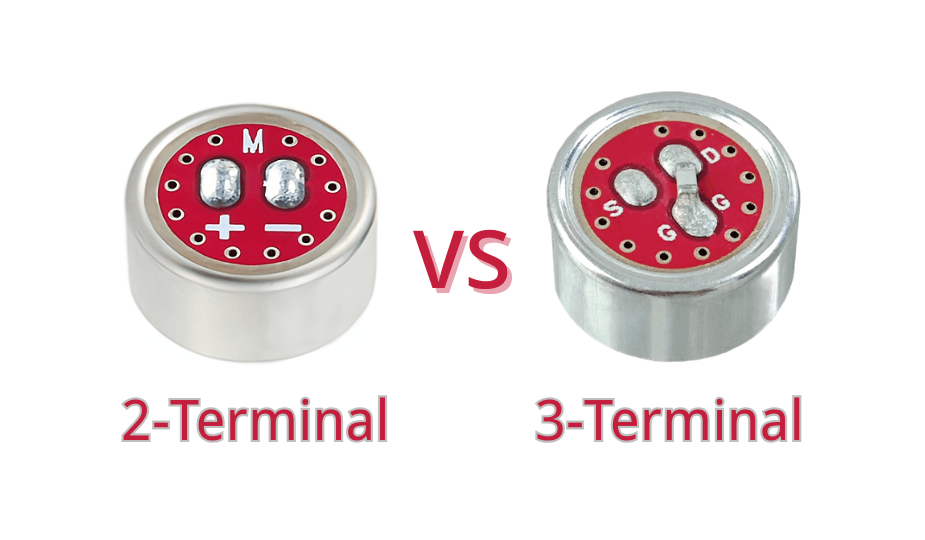
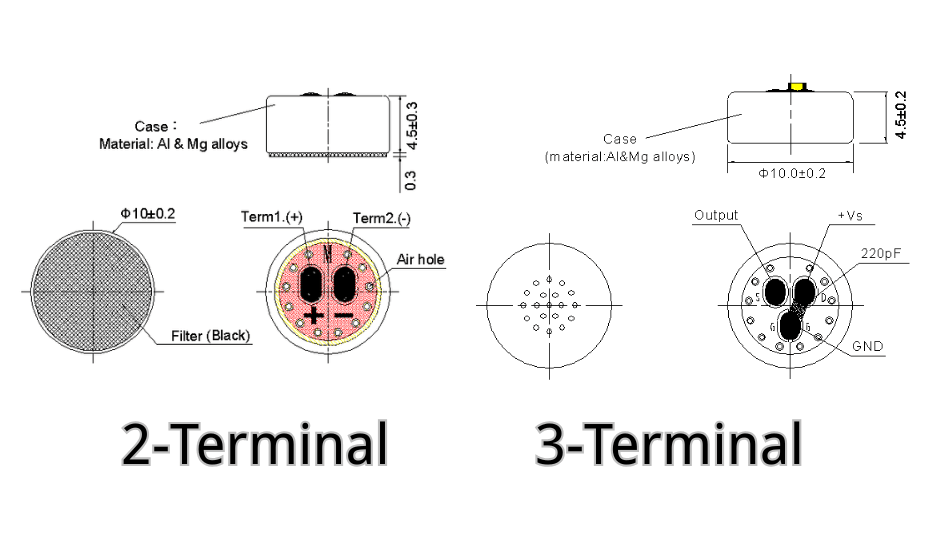
Electret microphones can be broadly classified by terminal type, typically into 2-terminal and 3-terminal designs. The most visible difference is the number of solder pads, but more important distinctions lie in their impedance and working voltage.
Typical Impedance and Voltage
| Terminal Type | Common Impedance | Less Common Impedance | Typical Voltage |
|---|---|---|---|
| 2-Terminal | 2KΩ | — | 1.5V, 2V |
| 3-Terminal | 1KΩ, 680Ω | 550Ω, 2.2KΩ | 1.5V, 2V, 3V, up to 5V |
2-Terminal Electret Microphones
Most 2-terminal microphones have a fixed impedance of 2KΩ and operate typically at 2V, with some low-voltage models at 1.5V. These microphones are easy to use, requiring only two connections for power and signal. The fixed impedance limits flexibility for circuit matching.
For more information on 2-terminal microphones, visit our 2-Terminal Electret Microphones product page.
3-Terminal Electret Microphones
3-terminal microphones feature separate terminals for ground, signal output, and bias voltage. This design allows a wider range of impedance and voltage options. The most common impedances are 1KΩ and 680Ω, while 550Ω and 2.2KΩ are rare. Working voltages range from 1.5V up to 5V.
For more details on 3-terminal microphones, visit our 3-Terminal Electret Microphones product page.
Applications of 3-Terminal Microphones
Their flexibility makes 3-terminal microphones ideal for higher-end audio devices, including:
- Noise-canceling headphones (high SNR required)
- Conference microphones (low noise, consistent output)
- Streamer or broadcaster microphones (high fidelity and high AOP)
Why Impedance and Voltage Matter
The impedance affects how the microphone interacts with downstream circuitry. Lower-impedance microphones can drive longer cables with less signal loss, while higher-impedance microphones work well for short connections.
The working voltage controls internal FET operation. 2-terminal microphones usually rely on a built-in FET powered from the signal line. 3-terminal microphones separate the bias supply, which improves circuit matching and allows more flexibility in performance.
Choosing Between 2-Terminal and 3-Terminal Microphones
- 2-Terminal: Easy to implement, standard voltage (1.5–2V), typical impedance 2KΩ, suitable for general-purpose devices.
- 3-Terminal: Flexible voltage (1.5–5V), impedance 680Ω–1KΩ common, 550Ω/2.2KΩ rare, ideal for high-performance applications with high-fidelity requirements.
Summary
Terminal count is the first visible difference, but the real distinctions lie in impedance, working voltage, and application flexibility. 2-terminal microphones are suitable for standard consumer products, while 3-terminal microphones excel in high-performance, high-fidelity scenarios.