In electret condenser microphones (ECMs), the internal impedance-conversion and amplification architecture plays a critical role in determining noise floor, linearity, dynamic range, and long-term operational stability. Among the available solutions, JFET and MOSFET architectures are the two most widely adopted approaches in the industry.
JFET-based ECMs have long been favored for their simplicity, stable performance, and ease of manufacturing. They remain a proven and reliable choice for many general-purpose and cost-sensitive audio applications.
However, for large-diaphragm microphone elements operating in professional audio environments, performance limitations related to linearity, headroom, and distortion become more pronounced. In these cases, a properly engineered MOSFET architecture offers a higher performance ceiling.
JFET and MOSFET in ECM Design
From an engineering perspective, the choice between JFET and MOSFET is not a matter of right or wrong, but of application requirements and execution capability.
JFET architectures provide inherently stable operation with good noise characteristics and strong tolerance to handling and environmental variation. This makes them highly suitable for standardized, high-volume microphone designs.
MOSFET-based designs, by contrast, demand tighter control over biasing, component selection, and electrostatic protection. When these factors are properly managed, MOSFET architectures enable:
- Extremely high input impedance
- Superior linearity under high sound pressure levels
- Lower distortion at elevated signal amplitudes
- Greater flexibility in dynamic headroom optimization
For large-diameter ECMs, these advantages translate directly into improved acoustic performance and long-term signal consistency.
High-End MOSFET Architecture and Performance Optimization
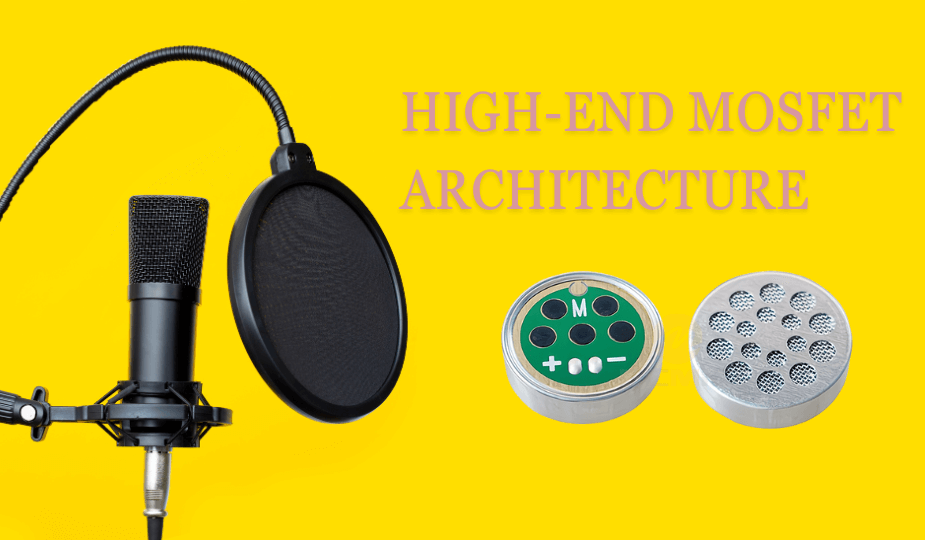
Building on long-term experience with electret microphone design, including extensive JFET-based platforms, we developed a 25mm ECM centered around a high-end MOSFET amplification architecture. This was a deliberate engineering decision aimed at achieving higher linearity, lower distortion, and improved performance stability for professional audio applications.
Rather than a single-step implementation, this MOSFET architecture has been continuously refined through iterative optimization of bias control, component selection, and environmental robustness. The result is a mature, production-ready design suitable for long-term OEM integration.
The current realization of this architecture is Model ECM-B2583UML32-23861, a large-diaphragm electret condenser microphone element optimized for demanding professional use cases.
Key Features of ECM-B2583UML32-23861
- SNR: 83 dB (typical)
- Max SPL: 120 dB
- Sensitivity: −32 ±2 dB
- Total Harmonic Distortion: ≤1%
- Operating Voltage: 1.0 – 10.0 V
- Output Impedance: ≤2 kΩ
- Pickup Pattern: Unidirectional (Cardioid)
- Housing: 25mm copper–nickel–zinc alloy for EMI shielding and acoustic stability
Application Scenarios for 25mm ECMs
Large-diaphragm ECMs are not intended for miniature or mobile electronics. Instead, they are optimized for fixed-installation and professional audio systems where sound quality, consistency, and durability are prioritized.
- Conference and discussion systems
- Broadcast and interview microphones
- Lectern and podium microphones
- Professional audio recorders
- Suspended or array microphone systems
- Industrial communication terminals
JFET and MOSFET: A Practical Engineering Comparison
| Feature | JFET | High-End MOSFET |
|---|---|---|
| Input impedance | High | Extremely high |
| Linearity | Good | Excellent |
| THD under high SPL | Low | Lower (with optimized bias) |
| ESD handling | Naturally robust | Design-controlled protection |
| Design complexity | Lower | Higher |
| Performance ceiling | Moderate | Higher |
Performance Built on Engineering Control
MOSFET technology is not inherently unstable. It simply requires tighter control over biasing, protection, and environmental variables. When properly engineered, MOSFET-based ECMs offer superior linearity, lower distortion, and greater dynamic headroom—particularly in large-diaphragm designs.
Our 25mm MOSFET-based electret microphones reflect this philosophy: performance achieved through controlled processes, validated testing, and real-world deployment experience.
Learn more about our 25mm cardioid ECM: ECM-B2583UML32-23861 Product Page
Contact us to request samples, technical documentation, or discuss OEM/ODM cooperation.