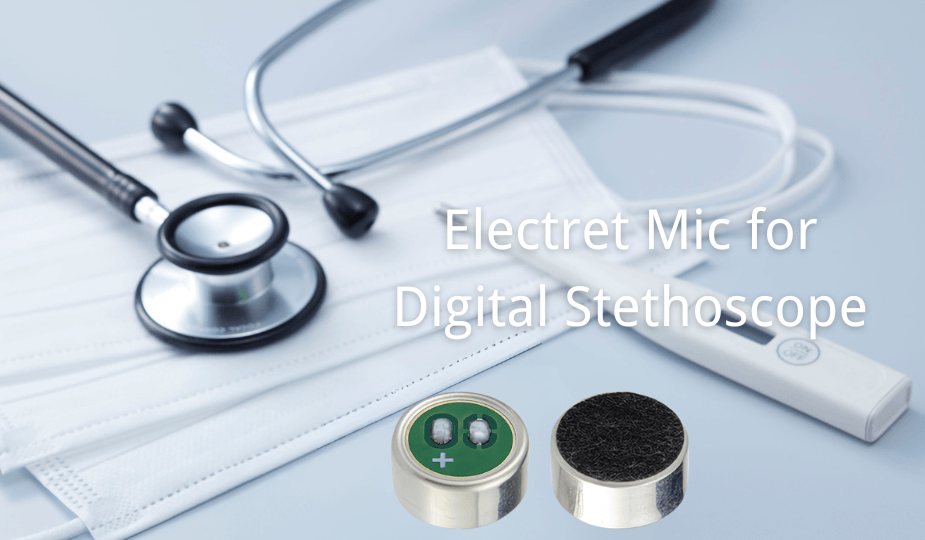
The shift toward digital stethoscopes has placed new demands on acoustic front-end components. Unlike traditional analog stethoscopes, digital versions require microphones that can capture subtle physiological sounds while rejecting mechanical noise from the housing and handling.
This guide covers the key specifications for electret condenser microphones (ECM) in digital stethoscope applications, along with practical considerations for integrating them into device housings.
Key Microphone Specifications for Digital Stethoscopes
Heart sounds and breath sounds are low-amplitude signals, typically ranging from 20 to 80 dB SPL, with most energy concentrated in the low-frequency spectrum. The microphone must be selected accordingly.
Sensitivity
- Target: -40 dB to -30 dB (0 dB = 1 V/Pa)
- Why it matters: Heart sounds are weak. Higher sensitivity ensures weak signals are captured without requiring excessive analog gain, which would amplify noise.
- Reference: Our 9.7mm omnidirectional electret microphone offers -26 ± 2 dB sensitivity, suitable for direct capture.
Signal-to-Noise Ratio (SNR)
- Target: ≥ 70 dB (A-weighted), preferably ≥ 75 dB
- Why it matters: Clinical environments are not acoustically controlled. High SNR helps separate physiological signals from ambient noise.
- Reference: SNR of 82 dB (typical) provides sufficient headroom for most applications.
Frequency Response
- Effective range: 20 Hz – 8 kHz, with a gentle roll-off above 4 kHz
- Why it matters: Heart sounds occupy 20–500 Hz; breath sounds extend to 2 kHz; murmurs and adventitious sounds can reach 4–8 kHz. Low-frequency extension is critical, while the high-frequency roll-off helps reject environmental noise that may alias into the audible band.
- Note: The published frequency response curve starts at 50 Hz, but effective performance extends to 20 Hz.
Directivity
- Recommendation: Omnidirectional
- Why it matters: In a sealed chestpiece cavity, omnidirectional microphones provide consistent response regardless of small assembly variations. Directional microphones can introduce variability in frequency response based on exact positioning.
Electrical Characteristics
- Operating voltage: 1.0–10.0 V (typical 2.0 V)
- Current consumption: ≤ 500 μA
- Output impedance: ≤ 2.2 kΩ
These parameters are suitable for battery-powered operation and standard audio front-end circuits.
Reliability Considerations
Medical devices require consistent performance across temperature, humidity, and mechanical stress. Standard reliability tests for this application include:
| Test | Condition |
|---|---|
| High temperature | +80°C, 100 hours |
| Low temperature | -40°C, 100 hours |
| Humidity | +55°C, 85% RH, 100 hours |
| Thermal shock | -40°C to +80°C, 10 cycles |
| Vibration | 10–55 Hz, 1.52 mm amplitude, 2 hours per axis |
| Drop | 1.0 m onto marble, 5 times |
These tests ensure the microphone maintains performance under typical use and storage conditions.
Common Integration Issue – Mechanical Noise in Sealed Cavities
A recurring question from customers involves noise pickup when the microphone is installed in a sealed housing:
“When the microphone is placed in a closed cavity, it produces a humming sound. Even slight touches or external disturbances on the cavity surface are being picked up.”
This is a mechanical coupling issue, not a microphone defect.
Root Cause Analysis
When a microphone is sealed inside a rigid cavity, the entire housing becomes a mechanical conductor. Touch, case resonance, or cable friction transmits vibration through the structure to the microphone’s internal FET, where it is converted to an electrical signal.
The intended signal (heart sounds) travels through air. The unwanted signal (handling noise) travels through solid structure. The microphone cannot distinguish between the two.
Mitigation Strategies – System-Level
Addressing this requires attention to mechanical, acoustic, and electrical design:
Mechanical Isolation
- Isolate the microphone from the housing using compliant materials (silicone gaskets, foam)
- Mount the microphone PCB on flexible circuits (FPC) rather than rigid connections
- Secure all internal cables to prevent friction against housing
Acoustic Chamber Design
- Keep the back chamber sealed and isolated from other compartments
- Optimize sound port diameter (0.8–1.5 mm) and length (≥ 3 mm)
- Use a PTFE membrane to seal the port while allowing sound transmission
Circuit and DSP
- Place the preamplifier as close to the microphone as possible
- Apply high-pass filtering (20–50 Hz) to reject low-frequency mechanical noise
- Implement touch-noise detection and adaptive suppression in firmware
The microphone alone cannot solve mechanical noise issues. System-level design determines final performance.
Frequently Asked Questions (FAQ)
Q1: Can I use a standard voice microphone for digital stethoscope applications?
A: Not recommended. Standard voice microphones typically have frequency response starting at 100 Hz, which attenuates critical heart sound frequencies below 100 Hz. For digital stethoscopes, a microphone with effective response down to 20 Hz is necessary.
Q2: Why does my microphone produce a humming sound when sealed in the housing?
A: This is typically caused by mechanical coupling between the microphone and the housing. When the microphone is rigidly mounted, vibrations from the housing are transmitted directly to the microphone. The solution involves mechanical isolation (silicone gaskets, foam) and proper acoustic chamber design.
Q3: Can ECMIC provide custom sensitivity or frequency response?
A: Yes. ECMIC offers customization services for sensitivity, frequency response, and mechanical dimensions based on volume requirements. Contact our technical support team with your specifications.
Q4: What is the difference between omnidirectional and directional microphones for this application?
A: Omnidirectional microphones are preferred for sealed chestpiece cavities because they provide consistent frequency response regardless of exact mounting position. Directional microphones can introduce variability if the sound port alignment shifts during assembly.
Q5: How do I test if the noise issue is from the microphone or the system design?
A: A simple method: remove the microphone from the housing while keeping it electrically connected. If the noise disappears, the issue is mechanical coupling or acoustic chamber design. If noise persists, evaluate the power supply, preamplifier circuit, and grounding.
Q6: What is the typical operating life of an ECM in a medical device?
A: ECMs are passive components with no wear mechanisms under normal operation. When used within specified electrical and environmental limits, they maintain performance for the expected lifetime of the device. Reliability tests (temperature, humidity, vibration) are conducted to ensure long-term stability.
Q7: Does the microphone require any special handling during assembly?
A: Yes. ESD protection is required during handling as the internal FET is static-sensitive. Soldering must follow the specification: iron temperature 360 ± 10°C, soldering time ≤ 3 seconds. The soldering fixture and operator must be properly grounded.
Selection Summary
| Application | Recommended Model | Key Parameters |
|---|---|---|
| Clinical-grade digital stethoscope | 9.7mm omnidirectional ECM | -26 dB sensitivity, 82 dB SNR, 20 Hz – 8 kHz effective range |
| Portable / entry-level | Consult for custom options | Based on specific requirements |
Conclusion
Selecting the right electret microphone for a digital stethoscope involves balancing sensitivity, SNR, frequency response, and reliability. Equally important is understanding that mechanical noise must be addressed at the system level—through mechanical isolation, acoustic chamber design, and signal processing.
ECMIC provides microphones designed for medical acoustic applications. For specific selection questions or integration support, technical documentation and application engineering assistance are available.