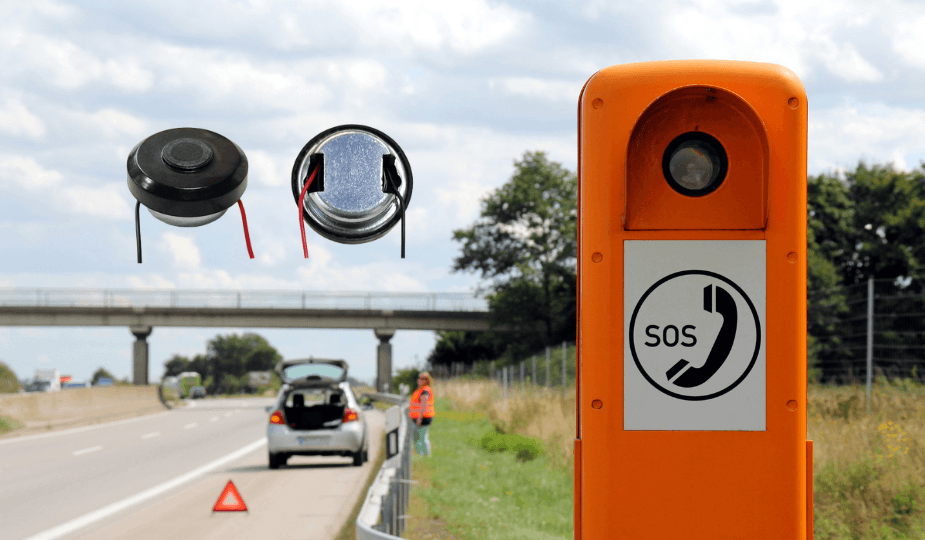
Emergency roadside telephones rely on clear and stable voice communication. For manufacturers, the microphone must meet acoustic requirements while matching the equipment’s electrical specifications, installation structure, and environmental conditions.
When selecting or replacing a microphone, key factors such as microphone type, impedance, dimensions, sensitivity, directionality, and waterproof performance should be evaluated before moving to production.
Why Microphone Selection Matters in Emergency Roadside Telephones
Emergency roadside telephones are designed for critical communication in outdoor environments. The microphone needs to provide reliable voice transmission while operating under conditions such as rain, humidity, temperature changes, and long-term outdoor exposure.
For manufacturers, the microphone should be evaluated as part of the complete communication system, including acoustic performance, electrical compatibility, mechanical installation, and environmental reliability.
Key Requirements for Emergency Roadside Telephone Microphones
1. Microphone Type
The first step is confirming the microphone type used in the existing equipment.
Dynamic microphones and electret condenser microphones have different electrical characteristics. A replacement microphone should match the original microphone type and the equipment’s circuit requirements.
For replacement projects, manufacturers can provide the existing microphone model, technical specifications, photos, or samples to help suppliers evaluate suitable options.
2. Impedance Matching
Impedance is an important specification for communication equipment microphones.
If the existing microphone uses a 200 Ω impedance, selecting a replacement microphone with the same or compatible impedance can help ensure proper integration with the existing circuit.
The ECM-DMP-21F dynamic microphone is a 200 Ω dynamic microphone designed for communication applications. It can be evaluated as a replacement option when the equipment requirements are compatible.
3. Mechanical Dimensions
A replacement microphone must fit the existing product structure without major modifications.
Important mechanical factors include:
- Overall dimensions
- Mounting method
- Available installation space
- Terminal or wiring configuration
- Housing and sealing structure
Matching the original microphone dimensions can simplify installation and reduce product redesign requirements.
4. Waterproof and Moisture Resistance
Outdoor emergency communication equipment requires microphones that can withstand moisture and environmental exposure.
When selecting a microphone, manufacturers should consider protective materials, sealing design, and the expected operating environment.
However, microphone waterproof performance alone does not determine the protection level of the complete telephone system. The final product design should also be evaluated as a whole.
5. Voice Clarity
The main purpose of an emergency telephone microphone is clear voice communication.
Besides sensitivity, manufacturers should consider frequency response, directionality, and the microphone position inside the equipment.
Actual installation testing is often the best way to confirm voice quality because the final performance depends on the complete acoustic design.
How to Select a Replacement Microphone
Before selecting a replacement microphone, manufacturers should compare the main specifications of the existing component.
| Specification | What to Confirm |
|---|---|
| Microphone type | Dynamic, electret condenser, MEMS, etc. |
| Impedance | Example: 200 Ω |
| Dimensions | Size and installation requirements |
| Sensitivity | Required voice pickup performance |
| Directionality | Omnidirectional or unidirectional pickup |
| Frequency response | Speech communication requirements |
| Environmental requirements | Waterproof or moisture resistance needs |
| Connection method | Terminals and wiring configuration |
Sample Testing Before Mass Production
For OEM manufacturers, sample testing is an important step before approving a replacement microphone for production.
A typical evaluation process includes:
- Confirm existing microphone specifications.
- Review potential replacement models.
- Install samples into the existing equipment.
- Test voice transmission and communication performance.
- Evaluate performance under expected operating conditions.
- Confirm the final specification before mass production.
This process helps ensure that the selected microphone works properly with the customer’s existing product design.
ECM-DMP-21F for Outdoor Communication Equipment
The ECM-DMP-21F is a waterproof dynamic microphone designed for marine VHF intercoms and other outdoor communication equipment.
Key specifications include:
- Microphone type: Dynamic microphone
- Impedance: 200 Ω
- Directivity: Unidirectional
- Sensitivity: -60 dB ±3
- Frequency response: 100 Hz–8 kHz
- Dimensions: 31.5 × 16.2 mm
For emergency roadside telephone projects requiring similar dimensions, 200 Ω impedance, and waterproof protection, the ECM-DMP-21F can be evaluated as a potential replacement through sample testing.
Learn more about the ECM-DMP-21F dynamic microphone
Working with an OEM Microphone Manufacturer
For manufacturers looking for a long-term microphone supplier, product specifications are only one part of the selection process.
Important factors also include:
- Product consistency
- Production capability
- Engineering support
- Sample evaluation support
- Customization capability
- Long-term supply stability
ECMIC supports customers with microphone selection, sample evaluation, and OEM/ODM microphone development based on specific product requirements.
Looking for a Replacement Microphone for Your Emergency Communication Equipment?
If you are developing or manufacturing emergency roadside telephones, outdoor intercoms, or other communication equipment, provide the following information:
- Existing microphone model
- Microphone type
- Impedance
- Sensitivity
- Dimensions
- Directionality
- Waterproof requirements
- Product photos or drawings
ECMIC can evaluate your requirements and recommend a suitable microphone solution for sample testing and production.