Selecting the wrong microphone capsule can add months to your development cycle and create warranty costs that erode your product margin.
We work with OEM buyers who face this decision daily. In this guide, we walk you through a 5-step procurement framework that helps you match capsule type to your product application, production scale, and reliability requirements.
By the end of this article, you will know exactly which capsule type fits your project — and what to ask your supplier before placing a production order.
Step 1: Define Your Application Environment
Before looking at any datasheet, start with three questions about your product’s real-world usage. Your answers will eliminate 70% of capsule options immediately.
Near-field or far-field voice pickup?
- Near-field (mouth within 5 cm): Headsets, intercoms, body cameras. You need noise-canceling or cardioid capsules that reject ambient sound.
- Far-field (speaker 30 cm or more): Conference systems, smart speakers, security cameras. You need omnidirectional capsules or multi-capsule arrays with higher sensitivity.
Indoor, outdoor, or industrial environment?
- Indoor: Standard ECM or MEMS capsules work well. Cost and production efficiency become your primary drivers.
- Outdoor / dusty / humid: You need waterproof capsules with IP57 or higher ratings.
- High-vibration / wide-temperature: Automotive-grade capsules or dynamic capsules offer better long-term reliability.
What is your annual production volume?
- Under 10,000 units/year: ECM capsules give you more flexibility with custom tuning and lower tooling costs.
- 50,000+ units/year: MEMS microphones support fully automated SMT assembly, which reduces labor cost and improves unit-to-unit consistency.
Procurement takeaway: Complete these three questions before you contact any supplier. This saves your engineering team weeks of back-and-forth and ensures you receive relevant samples from the start.
Step 2: Understand the 4 Core Capsule Types
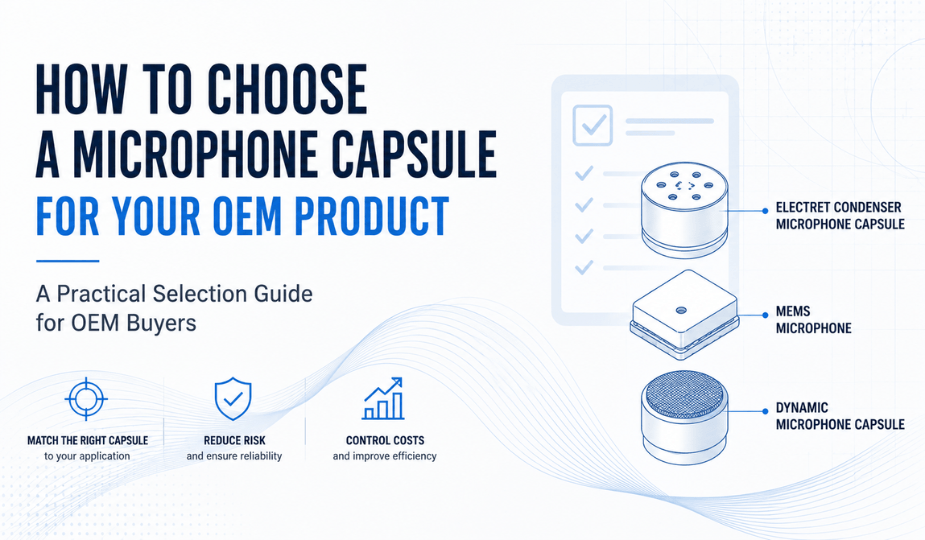
You do not need to memorize 15 different types. For 95% of OEM audio products, only four capsule families matter. Here is what each one does — and when to choose or avoid it.
For a complete reference covering all 15 capsule types used in commercial audio products, see our full guide on microphone capsule types.
| Capsule Type | Best Application | Procurement Advantage | When to Avoid |
|---|---|---|---|
| Electret Condenser (ECM) | Headsets, conference systems, security devices | Lowest cost, wide supplier base, easy custom tuning | Fully automated SMT production (manual assembly required) |
| MEMS | Smart speakers, wearables, IoT, high-volume consumer electronics | SMT-ready, excellent consistency, digital output options | Small-batch production (tooling costs are harder to amortize) |
| Dynamic | Stage, broadcast, public address, rugged communication | Handles high SPL, durable, no power required | Compact devices or battery-powered products (larger size, heavier) |
| Waterproof / IP-rated | Body cameras, outdoor intercoms, automotive, marine | Withstands dust, moisture, and temperature extremes | Indoor products where cost is the primary concern |
Procurement takeaway: Use this table as your shortlisting tool. If your application falls outside these four categories, you are likely over-engineering your solution — which adds cost without real performance gain.
From our experience at ECMIC: Across thousands of OEM projects, we consistently see buyers overcomplicate this decision. Most applications fall into one of the four categories above. We typically recommend a pilot batch of 100-500 capsules for process validation before full production. This single step prevents the majority of mass production issues we encounter.
Step 3: Translate Technical Specs into Procurement Decisions
Engineering teams often focus on specifications in isolation. As a buyer, you need to understand which specs actually affect your product’s success — and which ones are negotiable.
Sensitivity (mV/Pa or dBV/Pa)
Higher sensitivity means the capsule outputs a stronger signal for the same sound pressure. For far-field applications like conference systems, you want higher sensitivity (typically -38 dBV to -32 dBV). For near-field headsets, lower sensitivity (around -44 dBV) helps prevent overload and distortion.
Buyer tip: Do not chase the highest sensitivity spec. Match it to your preamplifier gain and ADC input range. Over-specifying sensitivity forces you to add attenuation circuitry, increasing your BOM cost unnecessarily.
Signal-to-Noise Ratio (SNR)
SNR directly impacts voice clarity in quiet environments. A 60 dB SNR capsule delivers noticeably cleaner audio than a 55 dB part. For speech applications, we recommend a minimum of 58 dB SNR for acceptable quality and 62 dB or higher for premium products.
Buyer tip: SNR is one of the few specs where paying slightly more directly improves user experience. We suggest prioritizing SNR over other parameters if your product competes on voice quality.
Acoustic Overload Point (AOP)
AOP defines the maximum sound pressure level the capsule can handle before distortion. For headsets and near-field devices, 120 dB SPL is sufficient. For stage or public address applications, you need 130 dB SPL or higher.
Buyer tip: Ignoring AOP is a common mistake. If your product will be used in noisy environments or close to loudspeakers, under-specifying AOP leads to distorted audio that no amount of digital post-processing can fix.
Frequency Response
Most ECM and MEMS capsules offer a frequency response of 100 Hz to 10 kHz. This range covers the human voice well. A wider response (down to 50 Hz or up to 20 kHz) benefits music recording but does not improve voice communication.
Buyer tip: Do not pay for extended frequency response unless your application specifically requires it. For voice products, a flat response within the speech band is far more important than extended bass or treble.
Step 4: Evaluate Your Supplier Against 5 Operational Criteria
Capsule performance on paper matters, but what determines your product’s success is how consistently your supplier delivers that performance at scale. Here is what we evaluate for every sourcing decision.
- Batch-to-batch consistency: Request CPK data from your supplier. A CPK ≥ 1.33 indicates a capable process. Without this data, you are taking a risk on production quality.
- Lead time stability: Ask about raw material buffer stock. Suppliers who hold 4-6 weeks of critical components protect you from market shortages. Those who do not will leave you scrambling when demand spikes.
- Engineering support responsiveness: Time your supplier’s response to a technical question. If they take more than 24 hours during sample evaluation, that same delay will multiply during production ramp-up.
- Custom tuning flexibility: Can the supplier adjust frequency response, sensitivity, or impedance to match your acoustic design? Suppliers with in-house tuning capabilities reduce your time-to-market by weeks.
- Quality system maturity: ISO 9001 and IATF 16949 certifications are baseline indicators. But also ask about their incoming material inspection rate and outgoing yield rate — these numbers tell you how much rework your factory will have to absorb.
Procurement takeaway: We suggest using this list as a supplier scorecard. Weight each criterion based on your priorities, and use it to compare candidates before committing to volume orders.
Step 5: Plan a 3-Stage Sample Validation Process
One round of acoustic testing is not enough. We recommend a three-stage validation that protects you from late-stage surprises.
- Stage 1 — Acoustic validation (2 weeks): Test sensitivity, SNR, frequency response, and AOP against your specifications. Compare at least 10 samples to assess initial variability.
- Stage 2 — Environmental validation (2-3 weeks): Run temperature cycling, humidity exposure, and drop tests that simulate your product’s shipping and usage conditions. This stage reveals reliability issues that acoustic tests do not catch.
- Stage 3 — Process validation (3-4 weeks): Have your supplier produce a pilot batch of 100-500 capsules using their full production process. Test these capsules to confirm that batch consistency matches the sample phase.
Procurement takeaway: Many OEM buyers skip Stage 2 or Stage 3 to save time. We have seen this decision create warranty costs that far exceed the development time saved. Complete all three stages, even if it adds 6-8 weeks to your timeline.
Example Selection Scenarios by Product Type
Here is how we guide clients across different product categories. Use this as a reference point for your own project.
| Product Type | Recommended Capsule | Key Consideration |
|---|---|---|
| Call Center Headset | Noise-Canceling ECM | Rejects background noise while preserving speech clarity |
| Conference System | Omnidirectional ECM | Wide pickup angle for multiple participants |
| Smart Speaker | Digital MEMS | PDM/I²S output simplifies integration with voice assistants |
| Body Camera | Waterproof ECM (IP57+) | Withstands outdoor exposure and physical shock |
| Aviation Headset | Noise-Canceling ECM | Rejects engine noise while preserving voice clarity |
| Marine Intercom | Waterproof Dynamic | Handles high humidity and salt spray |
| Bus PA System | Dynamic | Durable for high-noise public address environments |
Procurement takeaway: If your product type is not listed above, contact our engineering team with your application details. We provide personalized recommendations based on your specific use case and production requirements.
Understanding Total Cost of Ownership
A microphone capsule that costs $0.05 less per unit may increase warranty costs significantly if its consistency is poor. We encourage OEM buyers to evaluate total cost of ownership (TCO), not just component price.
5 Cost Factors Beyond Unit Price
- Component cost: The price per capsule. This is what most buyers focus on — but it is only the starting point.
- Engineering cost: How much time does your team spend tuning, testing, and troubleshooting? A capsule that requires less engineering effort reduces development expense.
- Assembly cost: ECM capsules require manual assembly in some cases. MEMS supports SMT automation. The difference in labor cost can outweigh the component price gap at scale.
- Warranty cost: Field failures due to inconsistent capsule performance can wipe out margin gains from lower unit pricing.
- Supply risk cost: A supplier with unstable lead times forces you to hold excess inventory or absorb expedite fees. Both increase your true cost.
Procurement takeaway: When comparing quotations from multiple suppliers, we suggest calculating TCO across these five factors. The supplier with the lowest unit price often ends up costing more over the full product lifecycle.
Your Microphone Procurement Checklist
Here is a one-page summary you can use for your next sourcing project.
- Defined near-field vs far-field application
- Identified environmental exposure level (indoor / outdoor / extreme)
- Matched capsule type to production volume (ECM for low-mid volume / MEMS for high-volume SMT)
- Selected sensitivity and SNR based on use case, not datasheet maximum
- Confirmed AOP meets your maximum sound pressure requirement
- Requested CPK data from potential suppliers
- Verified lead time stability and raw material buffer
- Confirmed in-house tuning capability
- Planned all 3 validation stages in your project schedule
Frequently Asked Questions
How early should I involve my microphone supplier in the product design cycle?
We recommend involving them during the industrial design phase. Acoustic port placement, seal design, and PCB layout all affect capsule performance. Suppliers can often spot design constraints that your engineering team may not anticipate.
What if my sample tests pass but mass production fails?
This usually points to a process control gap. This is exactly why we recommend Stage 3 validation (pilot batch testing) before full production. Review your supplier’s CPK data and incoming material inspection records to identify the root cause.
How do I compare quotations from different microphone suppliers?
Do not compare unit price alone. Request a full quotation that includes tooling cost, sample charges, engineering support fees, and logistics terms. Compare total project cost across suppliers, not just per-unit pricing.
What MOQ should I expect for custom-tuned capsules?
For ECM capsules, custom tuning typically requires a minimum order quantity of 5,000 to 10,000 units. MEMS custom tuning may require 20,000+ units due to ASIC programming costs. Discuss MOQ expectations early to avoid surprises at the production stage.
How can I reduce sourcing risk when choosing a microphone supplier?
We recommend qualifying at least two suppliers for critical components. Also, request production CPK data and audit the supplier’s quality system before placing volume orders. These steps reduce your exposure to supply disruptions.
What causes microphone price differences between suppliers?
Price differences typically arise from raw material quality, process control, yield rate, and test coverage. A lower-cost supplier may skip critical test steps or use lower-grade components. These factors affect your long-term product reliability.
When should I lock in a microphone supplier?
Lock in your supplier during the prototype validation phase, before you finalize the PCB layout and acoustic design. Changing the capsule type after design freeze adds significant re-engineering cost and delays your launch timeline.
Should I choose ECM or MEMS for a product that runs on battery power?
Both work well in battery-powered devices. MEMS microphones typically draw lower current (60-100 µA) compared to ECM capsules (200-500 µA). If your device runs on a small coin cell battery, MEMS offers a meaningful power advantage.
What is the typical tooling cost for a custom-tuned ECM capsule?
Tooling costs usually range from $1,000 to $3,000 for an ECM capsule, depending on the complexity of the tuning and housing design. This cost is amortized over your production volume. MEMS custom tuning requires higher upfront NRE ($10,000-$30,000) because it involves ASIC-level adjustments.
How much buffer stock should I hold for microphone capsules?
We typically recommend 4-6 weeks of finished goods buffer and an additional 4 weeks of component buffer from your supplier. This protects against sudden demand changes and supply chain disruptions without incurring excessive holding costs.
What is the typical lead time for custom-tuned capsules?
Custom ECM tuning usually takes 2-3 weeks for sample preparation and 4-6 weeks for production after approval. MEMS custom tuning requires 8-12 weeks due to ASIC programming and characterization. Factor this into your product launch timeline accordingly.
Do I need acoustic simulation before selecting a capsule?
Acoustic simulation helps, especially for products with complex porting or multiple microphones. However, for many OEM products, physical testing with a few candidate capsules is more practical and cost-effective. We recommend testing before investing in simulation tools.
About ECMIC
ECMIC is the audio division of Shenzhen Marquess Electronics Co., Ltd., specializing in electret condenser microphones, MEMS microphones, and dynamic microphone capsules for OEM buyers worldwide. We provide custom acoustic tuning, production consistency planning, and full technical support from sample evaluation to mass production.
If you are sourcing microphone capsules for your next product, contact our engineering team for a no-obligation consultation and sample evaluation.