When selecting a microphone capsule for product integration, cardioid is often the first choice for many engineers. But wide cardioid exists for a reason: some acoustic sources simply do not fit within a cardioid pickup pattern.
This guide explains wide cardioid’s characteristics, when it is the better choice, and what OEM designers need to consider when integrating wide cardioid capsules into their products.
1. What Is Wide Cardioid?
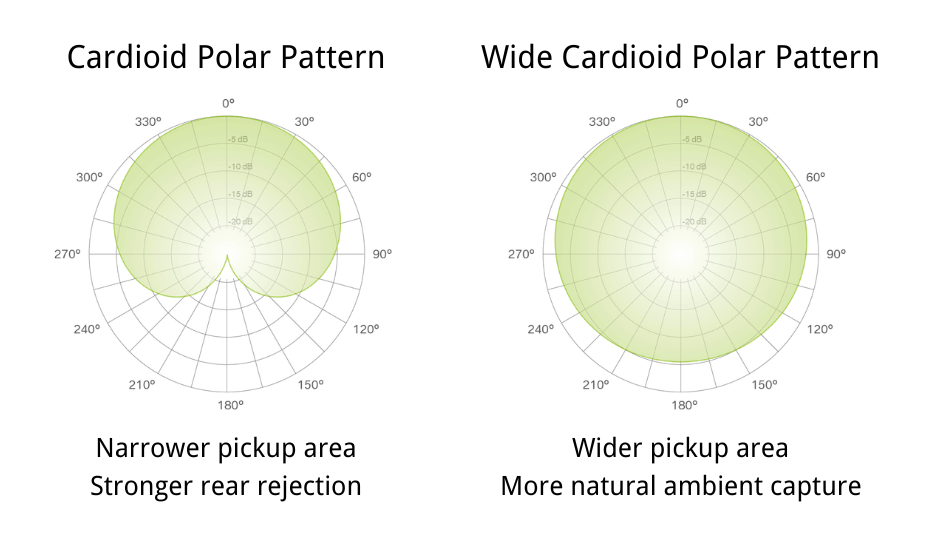
Microphone pickup patterns are not limited to a few fixed categories. They exist along a spectrum from omnidirectional to highly directional patterns. Wide cardioid falls between omnidirectional and cardioid — more directional than omni, less focused than cardioid.
| Pattern | Typical Pickup Angle | Side Attenuation (90°) | Rear Attenuation (180°) |
|---|---|---|---|
| Omnidirectional | 360° | 0dB | 0dB |
| Wide Cardioid | 120° – 180° | ~3dB | ~10dB |
| Cardioid | ~130° | ~6dB | >20dB |
Actual polar pattern performance may vary depending on capsule design, frequency range, and acoustic integration.
Note: Wide cardioid is sometimes referred to as subcardioid, although exact definitions vary between manufacturers. The key behavior is consistent: reduced side rejection compared to cardioid, resulting in a more open sound while still providing meaningful rear rejection.
From an engineering perspective, wide cardioid’s side attenuation of only about 3dB means off-axis sound is not strongly rejected. This is the opposite of cardioid’s design goal, which is to reject off-axis sound as much as possible.
2. Why OEM Engineers Choose Wide Cardioid Capsules
From an OEM design perspective, wide cardioid offers specific advantages that matter during product development:
- Reduce microphone count: One wide cardioid capsule may reduce the need for multiple cardioid capsules in certain applications.
- Simplify acoustic design: Less need for complex multi-microphone arrays or precise placement optimization.
- Capture natural sound: The pickup pattern captures more of the instrument’s natural sound distribution.
- Improve user experience: Products that deliver a more “open” and “natural” sound often provide a better listening experience.
For product designers, the decision to use wide cardioid often starts with a fundamental question: is the sound source a point or a broad area?
3. Application Scenarios: When Wide Cardioid Is the Right Choice
Wide cardioid is a specialized tool for broad sound sources — instruments or ensembles where sound does not originate from a single point.
Piano
A piano is the classic wide cardioid application. The soundboard spans over a meter, low and high strings radiate differently, and the instrument’s full character is only captured when the microphone “sees” the entire source. A single wide cardioid capsule can cover the piano’s full width more naturally than a cardioid.
Drum Overheads
Drum kits are wide. Wide cardioid overheads cover the entire kit more evenly, capturing cymbals, toms, and snare in better balance. The wider pickup angle may allow more flexible microphone placement compared with narrower pickup patterns.
Choirs and Ensembles
For vocal groups or instrumental ensembles, wide cardioid captures the full breadth of the group while still providing directionality to reduce unwanted room sound. It offers a more natural representation than cardioid, which can sound too “focused” for group recordings.
Large Instruments (Pipe Organ, Marimba, etc.)
Pipe organs, marimbas, and other large instruments with distributed sound sources benefit from the wide pickup pattern. The capsule captures the instrument’s full range without overemphasizing one section.
When to Stick with Cardioid
- Live sound reinforcement (higher isolation = better gain-before-feedback)
- Close-miking individual instruments where bleed must be minimized
- Noisy environments where off-axis rejection is critical
- Spot miking in multi-mic setups
4. Capsule-Level Considerations for OEM Designers
When integrating a wide cardioid capsule into a product, several parameters require attention:
Sensitivity and SNR
Wide cardioid capsules are available in a range of sensitivity values, typically -38dB to -45dB. Higher sensitivity is generally preferred for acoustic instrument applications where sound levels may be moderate.
Typical SNR ranges from 60dB to 65dB+, depending on capsule design.
Frequency Response
Wide cardioid capsules typically offer a frequency response range of 50Hz–16kHz. For piano and drum applications, a well-extended low-frequency response helps preserve natural instrument tone.
Housing and Acoustic Integration
Unlike finished microphones, microphone capsules require careful acoustic matching during product development. The final performance is affected by:
- Housing geometry and port placement
- Damping material selection
- Mechanical isolation from vibration
- PCB layout and grounding
These factors must be considered together during the design phase, not treated as separate decisions.
5. ECMIC Wide Cardioid Capsule Options
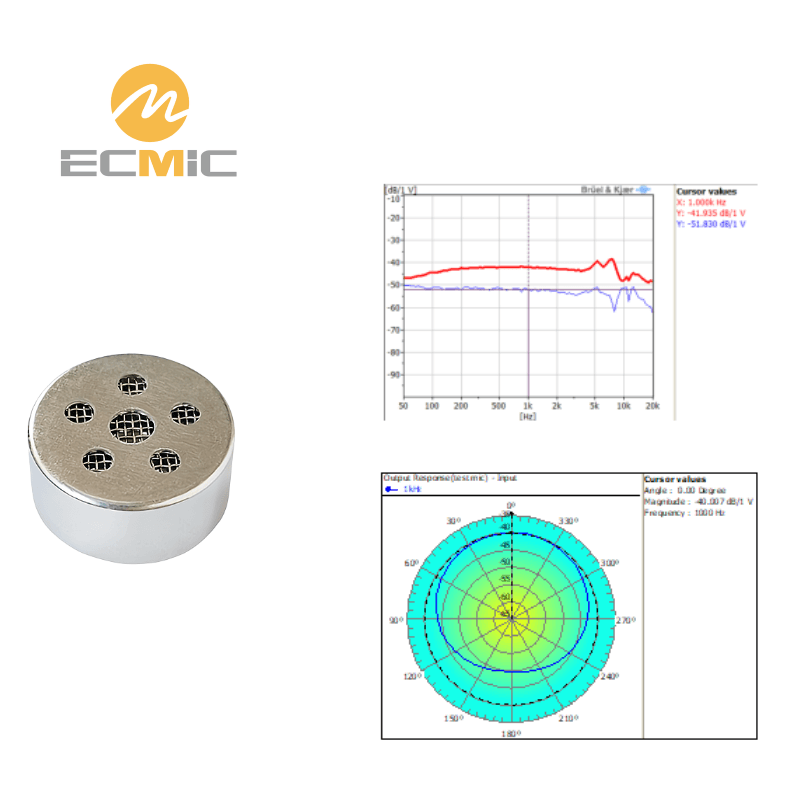
ECMIC manufactures wide cardioid electret condenser microphone capsules for OEM and ODM integration. Our standard capsule offering includes the following key parameters:
| Parameter | Typical Range |
|---|---|
| Directivity | Wide Cardioid (120°–180° range) |
| Sensitivity | -45dB to -38dB (customizable) |
| SNR | 60dB – 65dB+ (customizable) |
| Max SPL | 110dB – 120dB |
| Frequency Response | 50Hz – 16kHz (typical) |
| Size | 9.7mm, 14mm, and other sizes available |
For OEM and ODM projects, ECMIC supports customization including:
- Capsule diameter and height
- Sensitivity tuning
- Frequency response shaping
- Housing modifications
- Terminal type (pins, pads, or wire leads)
- Acoustic port configuration
Learn more about our wide cardioid capsule: Wide Cardioid Microphone Capsule
6. Summary
| Application | Recommended Pattern | Reason |
|---|---|---|
| Piano (single or stereo pair) | Wide Cardioid | Captures full instrument width |
| Drum overheads | Wide Cardioid | Even coverage across the kit |
| Choir / ensemble | Wide Cardioid | Natural balance without excessive room sound |
| Large instruments | Wide Cardioid | Full-range capture without hot spots |
| Close-miked solo instrument | Cardioid | Isolation and control |
| Live vocal / stage | Cardioid | Maximum off-axis rejection |
Selection principle: Point sources → cardioid. Broad sources → wide cardioid.
If your product needs to capture broad sound sources naturally and efficiently, wide cardioid is the pickup pattern worth specifying.
Request a sample or discuss your capsule requirements: Contact ECMIC engineering team