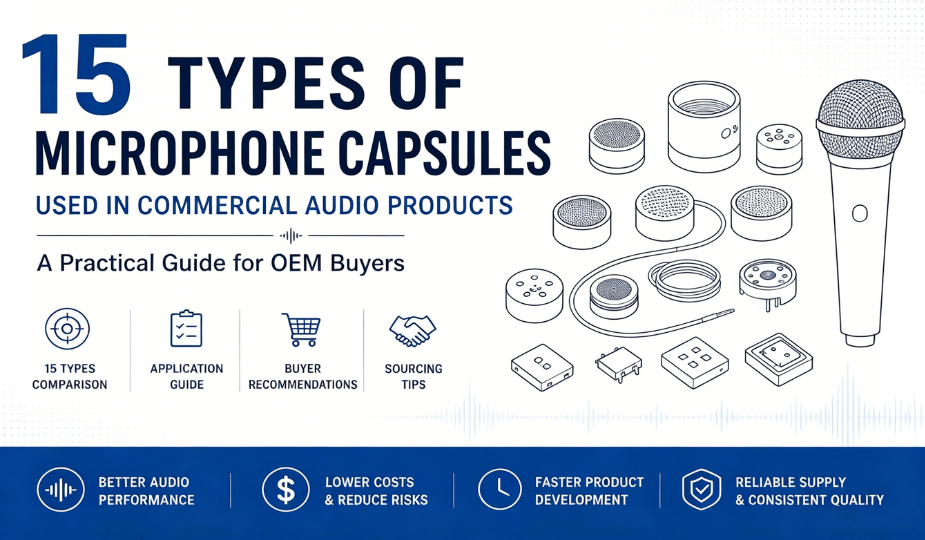
Selecting the right microphone capsule can improve product performance, reduce development risks, and help your team reach mass production faster.
If you already have a shortlist and need a structured decision framework for comparing suppliers and validating samples, see our 5-step procurement guide for OEM buyers.
At ECMIC, we specialize in helping OEM buyers across headsets, conference systems, body cameras, and smart devices match capsule types to their specific applications. This guide reflects what we have learned from thousands of projects — and we wrote it to help you avoid the costly mistakes we see most often.
Many OEM buyers focus on microphone specifications after the product design is nearly complete. In practice, this often leads to acoustic issues, redesign costs, and project delays.
If you are developing a headset, conference system, body camera, smart device, or professional audio product, understanding the major microphone capsule types can help you make better sourcing decisions from the start.
Quick Comparison of Microphone Capsule Types
| Type | Best For | Cost Level | Main Advantage | Procurement Consideration |
|---|---|---|---|---|
| Electret Condenser (ECM) | Headsets, Conference Systems | Low | Excellent balance of cost and performance | Manual assembly required. If volume exceeds 50K/year, calculate SMT labor savings before finalizing |
| MEMS | IoT Devices, Smart Electronics | Medium | Supports automated SMT production | Higher tooling cost. Best amortized over large production runs |
| Dynamic | Stage and Broadcast Equipment | Medium | Handles high sound pressure levels | Larger size. Confirm mechanical fit before designing enclosure |
| Noise-Canceling | Communication Headsets | Medium | Reduces background noise | Performance depends on acoustic port placement. Request reference design from supplier |
| Waterproof | Outdoor Products | High | Improved environmental protection | Adds 30-60% cost. Confirm IP rating matches your actual usage |
Why Microphone Capsule Selection Matters
A microphone capsule is not simply an audio component. It directly affects voice clarity, user experience, production consistency, and product reliability.
The wrong capsule can increase engineering work and create unnecessary warranty costs after launch.
For OEM manufacturers, selecting the correct microphone early can significantly reduce project risks.
1. Electret Condenser Microphone Capsules
Electret condenser microphones remain the most widely used microphone technology in commercial audio products.
Typical Applications
- Conference systems
- Headsets
- Security cameras
- Intercom systems
Buyer Recommendation
If your project requires strong voice performance while maintaining cost competitiveness, ECM capsules are often the safest choice.
For many OEM products, ECM technology still delivers the best overall value.
When to avoid: If your production line is fully automated SMT, ECM’s manual assembly requirement may add labor cost that offsets its price advantage.
2. MEMS Microphones
MEMS microphones are manufactured using semiconductor processes and support highly automated production.
Typical Applications
- Smart speakers
- Wearable devices
- IoT products
- Voice-controlled electronics
Buyer Recommendation
If your production relies heavily on SMT assembly, MEMS microphones may improve manufacturing efficiency and consistency.
When to avoid: For small-batch production under 10,000 units, the tooling cost of MEMS may be harder to amortize compared to ECM.
3. Dynamic Microphone Capsules
Dynamic microphone capsules use a moving coil structure and perform well in high-noise environments.
Typical Applications
- Broadcast microphones
- Stage microphones
- Public address systems
- Communication equipment
Buyer Recommendation
For products operating in demanding environments, dynamic capsules often provide long-term reliability advantages.
When to avoid: Dynamic capsules are larger and heavier than ECM or MEMS. If your product is battery-powered or compact, the size and weight may be a constraint.
4. Omnidirectional Microphone Capsules
Omnidirectional microphones capture sound from all directions.
They are commonly used when the user’s speaking position cannot be controlled.
When to avoid: If your product operates in noisy environments, omnidirectional capsules will pick up ambient noise and reduce speech clarity.
5. Cardioid Microphone Capsules
Cardioid microphones focus on sound from the front while reducing unwanted noise from other directions.
When to avoid: If you need to capture sound from multiple participants around a table, a cardioid capsule is too directional and will miss voices off-axis.
6. Supercardioid Microphone Capsules
Supercardioid microphones offer narrower pickup patterns and improved noise rejection.
When to avoid: The narrow pickup pattern requires precise user positioning. For consumer products where users vary their speaking position, the audio level may be inconsistent.
7. Noise-Canceling Microphone Capsules
Noise-canceling designs improve speech intelligibility in noisy environments.
When to avoid: Noise-canceling capsules typically have lower sensitivity than omnidirectional types. For far-field applications, this can reduce overall system gain.
8. Dual-Capsule Microphone Systems
Dual-capsule designs combine signals from multiple microphones for better voice processing performance.
When to avoid: This adds cost and complexity. Consider whether a single capsule can meet your requirements before designing in a dual-capsule system.
9. Analog MEMS Microphones
Analog MEMS microphones simplify integration with traditional audio circuits.
When to avoid: If your system uses digital processors, analog MEMS requires an additional ADC stage that digital MEMS can skip.
10. Digital MEMS Microphones
Digital MEMS microphones provide outputs such as PDM and I²S.
When to avoid: If your processor does not support PDM or I²S input, you will need an external interface chip.
11. Waterproof Microphone Capsules
Designed for products exposed to dust, moisture, and outdoor conditions.
When to avoid: Waterproof capsules add significant cost and may have reduced sensitivity due to the protective membrane. Only choose this type if your product requires an IP rating.
12. Automotive-Grade Microphone Capsules
Built for long-term reliability under vibration and temperature fluctuations.
When to avoid: The cost premium for automotive-grade qualification is not justified for consumer electronics that operate in controlled environments.
13. Broadcast-Grade Microphone Capsules
Optimized for professional audio applications where sound quality is critical.
When to avoid: The price point is significantly higher than standard capsules. Only invest in broadcast-grade if your product competes in the professional audio market.
14. Miniature Microphone Capsules
Ideal for compact electronic devices with limited installation space.
When to avoid: Miniature capsules typically have lower SNR than standard-sized capsules. Check that the acoustic performance meets your requirements before compromising on size.
15. Custom-Tuned Microphone Capsules
Custom acoustic tuning helps OEM manufacturers create differentiated products.
When to avoid: Custom tuning adds development time and cost. If standard capsules can meet your specifications, use them to shorten your time-to-market.
Which Microphone Capsule Is Best for Your Application?
| Application | Recommended Type | Key Procurement Question to Ask Your Supplier |
|---|---|---|
| Conference Systems | Omnidirectional ECM | “What SNR do I need for a room this size?” |
| Communication Headsets | Noise-Canceling ECM | “Does this capsule reject wind noise effectively?” |
| Body Cameras | Waterproof ECM | “What IP rating is sufficient for my environment?” |
| Smart Speakers | Digital MEMS | “Does my processor support PDM input?” |
| Broadcast Equipment | Dynamic or Broadcast-Grade ECM | “What AOP do I need for close-mic applications?” |
Frequently Asked Questions
If I’m designing a headset, do I need a noise-canceling capsule or a cardioid capsule?
It depends on the usage environment. For call center headsets in noisy offices, noise-canceling ECM is the better choice. For aviation headsets where engine noise is persistent, cardioid designs are more effective at rejecting ambient sound.
What SNR level should I accept for a conference system?
We recommend a minimum of 58 dB SNR for acceptable voice quality. For premium conference systems where participants are far from the microphone, 62 dB SNR or higher is preferred.
How do I know if I need waterproofing? What IP rating is sufficient?
Assess your product’s actual exposure to moisture. IP57 is sufficient for occasional outdoor use or rain exposure. IP67 is recommended for products that may be submerged briefly. Do not pay for waterproofing you do not need.
Can I use the same capsule for indoor and outdoor products?
You can, but we do not recommend it. Waterproof capsules cost more and often have lower sensitivity. Standardize on a waterproof capsule only if your product line includes both indoor and outdoor variants.
How many samples should I test before making a final selection?
Request at least 20 samples from your supplier. Test 10 for acoustic parameters (sensitivity, SNR, frequency response) and 10 for mechanical or environmental reliability.
What questions should I ask my supplier before placing a volume order?
Ask for CPK data on sensitivity and SNR, lead time stability, incoming material inspection rates, and outgoing yield rates. These numbers tell you more than the datasheet ever will.
How do I verify that my supplier’s capsule will perform consistently at scale?
Request lot-to-lot comparison data from their last three production batches. A CPK ≥ 1.33 indicates a stable process. If the supplier cannot provide this data, treat it as a red flag.
What is the typical lead time for custom-tuned capsules?
Custom ECM tuning usually takes 2-3 weeks for sample preparation and 4-6 weeks for production after approval. MEMS custom tuning requires 8-12 weeks due to ASIC programming.
What is the difference between analog and digital MEMS, and which one should I choose?
Analog MEMS outputs an analog voltage that connects to your codec’s analog input. Digital MEMS outputs a PDM or I²S signal directly. Choose digital MEMS if your processor supports PDM/I²S input — it simplifies PCB layout and reduces noise pickup.
What factors affect microphone reliability?
Environmental conditions (temperature, humidity, vibration), supplier consistency, manufacturing quality, and acoustic design all play important roles. The capsule itself is rarely the sole factor — the enclosure and port design are equally critical.
Need Help Selecting the Right Microphone Capsule?
ECMIC supports OEM manufacturers with electret condenser microphones, MEMS microphones, dynamic microphone capsules, and custom acoustic tuning solutions.
Our engineering team has helped hundreds of buyers across headsets, conference systems, body cameras, and smart devices make the right selection for their specific applications.
Contact us to discuss your project requirements and sourcing goals.